|
Legal & Tax Disclosure
ATTORNEY ADVERTISING.
This article is provided for general informational purposes only and does not constitute legal, financial, or tax advice. Reading this content does not create an attorney-client or professional advisory relationship. Laws vary by jurisdiction and are subject to change. You should consult a qualified professional regarding your specific circumstances. |
Emily just discovered her aunt’s Will, but it’s a mess. The Will was signed twenty years ago, and Emily was listed as a witness and a beneficiary. Her cousin is now challenging the entire document, claiming Emily’s dual role automatically invalidates it. Emily is frantic – this Will represents everything she and her aunt discussed regarding the family cabin, a place with deep sentimental value. She fears losing not only the property but also the entire inheritance, and the legal fees are already mounting.
The question of whether a witness can also be a beneficiary to a California Will is surprisingly complex. It’s not an automatic invalidation, but it’s a situation fraught with potential challenges and strict rules. California Probate Code § 6112 governs this issue, and it hinges on whether the Will contains a “no-contest” clause (also known as an in terrorem clause).
Without a no-contest clause, a beneficiary-witness generally can be a valid witness to the Will. However, there’s a significant catch. The witness-beneficiary creates a presumption of undue influence, meaning the court will scrutinize the Will much more closely. The proponent of the Will (the person offering it for probate) has the burden of proving that the testator (the person making the Will) executed the document freely and voluntarily, without being unduly influenced by the witness-beneficiary. This requires compelling evidence – clear testimony, documentation demonstrating the testator’s independent thought, and a corroborating narrative that supports the Will’s terms. Failing to overcome this presumption can lead to the Will being deemed invalid.
Now, let’s address the presence of a no-contest clause. If the Will includes a clause stating that any challenge to the document results in the challenger forfeiting their inheritance, the analysis shifts dramatically. In this scenario, Emily’s cousin is in a precarious position. If he successfully challenges the validity of the Will based on Emily’s dual role, he risks losing his share of the estate. However, if his challenge fails, he receives nothing. It’s a high-stakes gamble. California law specifically addresses this scenario. If a no-contest clause exists, a challenge to the Will by a beneficiary-witness is only valid if the challenge is brought in good faith and with probable cause. This is a heightened standard, requiring more than just a hunch.
Furthermore, the number of witnesses also matters. California law requires two witnesses to a Will. If Emily is one of only two witnesses, the challenge is significantly stronger. The loss of her testimony as a witness could be fatal to proving the Will’s validity. Conversely, if there are multiple witnesses, her potential bias is diluted, and the court is more likely to accept the Will as genuine.
As a CPA as well as an estate planning attorney with over 35 years of experience, I frequently advise clients on the tax implications of these scenarios. A Will contest, even a successful one, can be costly and time-consuming, potentially eroding the estate’s value. Consider also that if real property is involved, like Emily’s family cabin, the beneficiaries may be impacted by AB 2016 (Probate Code § 13151). For deaths on or after April 1, 2025, a primary residence worth $750,000 or less (gross value) may qualify for a simplified transfer under AB 2016, bypassing formal probate. This simplified process wouldn’t be available if a protracted legal battle invalidates the original Will. If business assets are involved, remember that as of January 1, 2026, non-exempt LLCs must comply with FinCEN’s Beneficial Ownership Information (BOI) reporting; executors and beneficiaries managing inherited entities must file updated reports within 30 days of ownership changes to avoid significant civil penalties.
It’s also crucial to think about digital assets. Under California’s RUFADAA (Probate Code § 870), beneficiaries and executors are legally barred from accessing digital accounts, photos, and crypto-wallets unless the decedent explicitly granted authority in their Will, Trust, or via an ‘online tool’. A contested Will makes accessing these accounts far more complicated. Finally, remember that assets without valid beneficiaries may trigger probate if the total value of personal property exceeds $208,850 (for deaths occurring on or after April 1, 2025); a Will alone does not bypass this limit.
Ultimately, whether a beneficiary can also be a witness depends heavily on the specific facts of the case. While not automatically invalidating, the situation opens the door to challenges and heightened scrutiny. It’s a legal minefield that requires careful navigation and a thorough understanding of California probate law.
What does a California probate court look for when interpreting testamentary intent?
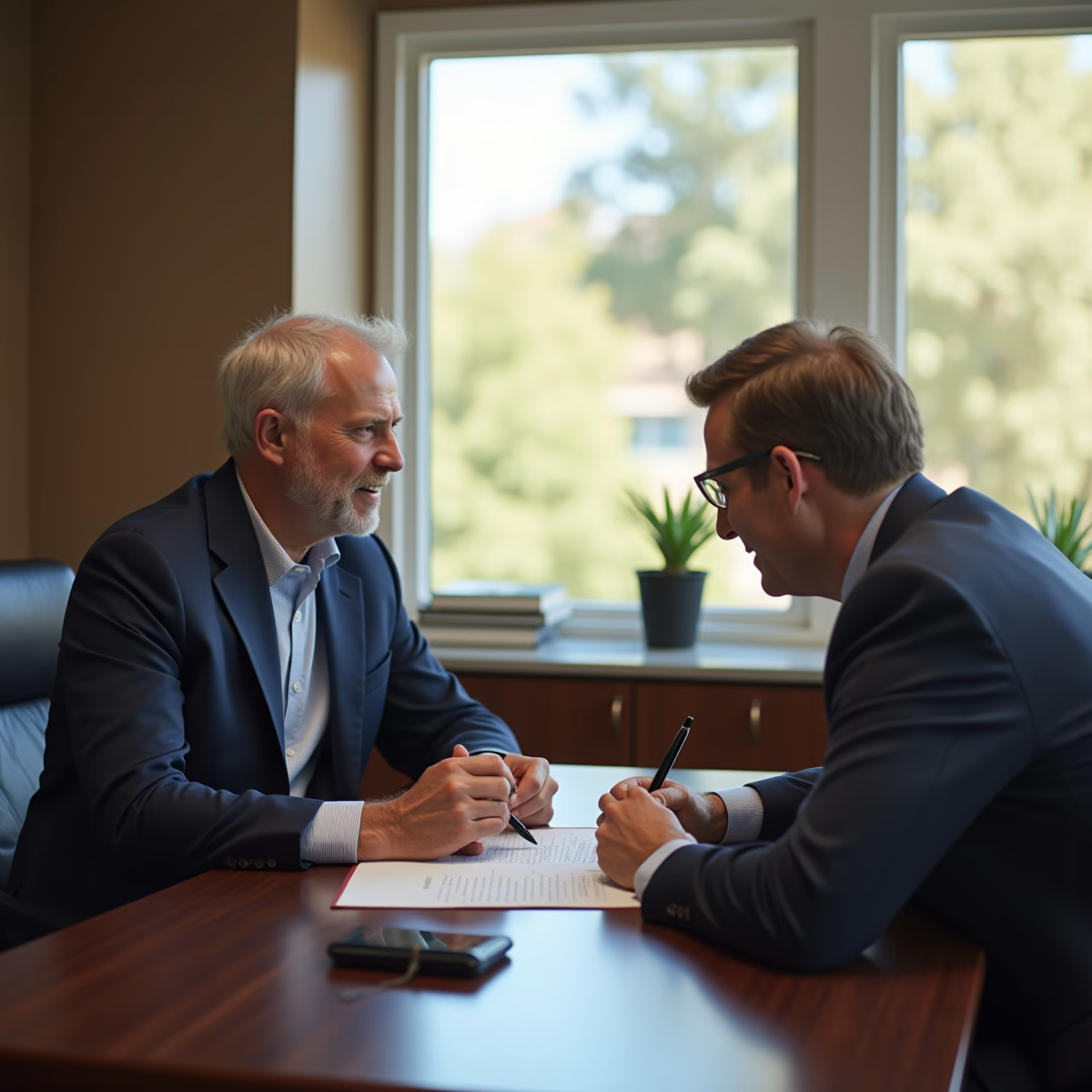
In California, a last will and testament is reviewed under probate standards that focus on intent, capacity, and execution. Clear drafting reduces ambiguity, limits misinterpretation, and helps families avoid unnecessary conflict during estate administration.
To ensure the will functions as intended, the executor must understand their executor duties, while the family should be prepared for the court supervision required to enforce the document.
For California residents, understanding how intent, authority, and compliance interact is one of the most effective ways to protect family harmony and estate integrity. A will that anticipates probate scrutiny is far more likely to be honored as written and far less likely to become the source of unnecessary conflict.
Official Resources for Probate, Legal Standards, and Tax Rules
-
Probate / Beneficiaries:
Riverside Superior Court – Probate Division:
Provides essential Riverside-specific “Local Rules” (Title 7) and forms effective January 1, 2026. This portal includes the mandatory eSubmit protocols for Temecula filings and the calendar for the Probate Division at the Historic Courthouse. -
Legal Standards:
State Bar of California:
The official regulatory agency for California’s 270,000+ attorneys; use this portal to verify a lawyer’s license status, check for a history of disciplinary actions, and access the 2026 guidelines for ethical attorney-client fee agreements. -
Tax / Estate Tax:
IRS Estate Tax Guidelines:
The authoritative federal resource for estate and gift tax filing; this page reflects the permanent exemption of $15 million per individual (effective Jan 1, 2026), which replaced the scheduled “tax cliff” from previous legislation. -
Self-Help / Forms:
California Courts – Wills, Estates, and Probate:
The Judicial Council’s primary self-help center offering standardized forms for 2026, including the updated $208,850 “Small Estate Affidavit” and the $750,000 “Primary Residence” simplified transfer procedure (AB 2016).
|
Attorney Advertising, Legal Disclosure & Authorship
ATTORNEY ADVERTISING.
This content is provided for general informational and educational purposes only and does not constitute legal, financial, or tax advice. Under the California Rules of Professional Conduct and State Bar advertising regulations, this material may be considered attorney advertising. Reading this content does not create an attorney-client relationship or any professional advisory relationship. Laws vary by jurisdiction and are subject to change, including recent 2026 developments under California’s AB 2016 and evolving federal estate and reporting requirements. You should consult a qualified attorney or advisor regarding your specific circumstances before taking action.
Responsible Attorney:
Steven F. Bliss, California Attorney (Bar No. 147856).
Local Office:
The Law Firm of Steven F. Bliss Esq.43920 Margarita Rd Ste F Temecula, CA 92592 (951) 223-7000
The Law Firm of Steven F. Bliss Esq. is a practice location and trade name used by Steven F. Bliss, Esq., a California-licensed attorney.
About the Author & Legal Review Process
This article was researched and drafted by the Legal Editorial Team of the Law Firm of Steven F. Bliss, Esq.,
a collective of attorneys, legal writers, and paralegals dedicated to translating complex legal concepts into clear, accurate guidance.
Legal Review:
This content was reviewed and approved by Steven F. Bliss, a California-licensed attorney (Bar No. 147856). Mr. Bliss concentrates his practice in estate planning and estate administration, advising clients on proactive planning strategies and representing fiduciaries in probate and trust administration proceedings when formal court involvement becomes necessary.
With more than 35 years of experience in California estate planning and estate administration,
Mr. Bliss focuses on structuring enforceable estate plans, guiding fiduciaries through court-supervised proceedings, resolving creditor and notice issues, and coordinating asset management to support compliant, timely distributions and reduce fiduciary risk. |