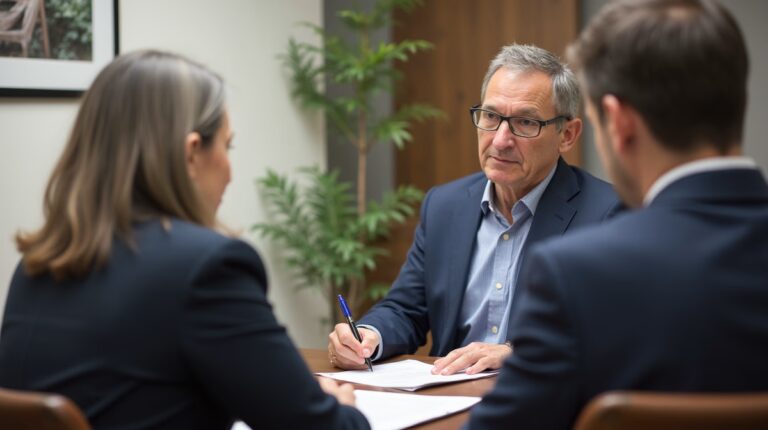
|
Legal & Tax Disclosure
ATTORNEY ADVERTISING.
This article is provided for general informational purposes only and does not constitute legal, financial, or tax advice. Reading this content does not create an attorney-client or professional advisory relationship. Laws vary by jurisdiction and are subject to change. You should consult a qualified professional regarding your specific circumstances. |
Emily called me last week, frantic. Her husband, Robert, a tech entrepreneur, had passed away unexpectedly. She’d located his revocable living trust – a good start – but it was drafted fifteen years ago, before the cryptocurrency boom. While the trust held his brokerage accounts and real estate, a significant portion of his wealth was tied up in various altcoins and NFTs. The original trust document didn’t mention digital assets at all. Now, Emily is facing not only grief but also a legal quagmire trying to access and properly value these holdings, potentially costing her tens of thousands in legal fees and lost opportunity.
This scenario is becoming increasingly common. Traditional estate plans often fall short when dealing with rapidly evolving asset classes. High-volatility assets – cryptocurrencies, NFTs, private equity, even certain startups – require a proactive and specialized approach. It’s not enough to simply name a beneficiary; you need to equip your trustee with the authority and tools to navigate these complex landscapes.
What Exactly Constitutes a “High-Volatility Asset?”

Generally, we’re talking about investments that experience significant price swings in short periods. Cryptocurrencies are the most obvious example, but the category extends to include venture capital investments, private company stock, certain collectibles, and even some real estate markets. These assets are often illiquid, meaning they aren’t easily converted to cash, and valuation can be subjective, leading to potential disputes among beneficiaries.
How Do You Protect Your Estate from Volatility?
Several strategies can mitigate the risks associated with high-volatility assets. First, consider diversifying your holdings. Overconcentration in a single volatile asset dramatically increases your exposure. Second, and critically, explicitly address these assets in your trust document. Don’t rely on general language; be specific. Grant your trustee the power to manage, sell, and distribute these assets, even if their value fluctuates dramatically. This requires clear and unambiguous wording.
What About Digital Asset Access?
This is a major pain point. Without specific RUFADAA language (Probate Code § 870) in your trust, service providers like Apple, Google, and Coinbase can legally deny your successor trustee access to your digital photos, emails, and cryptocurrency. Your trust needs to grant your trustee the authority to access your digital accounts and to take the steps necessary to transfer ownership of digital assets. This includes documenting private keys, seed phrases, and account access information—securely, of course. I strongly advise a dedicated digital asset inventory, kept separate from the core trust documents, with instructions for accessing each account.
I’ve been practicing estate planning and as a CPA for over 35 years, and I’ve seen firsthand how inadequate planning can devastate a family. My CPA background is particularly helpful here. Understanding the tax implications of these assets—capital gains, step-up in basis, and potential gift tax consequences—is essential for minimizing estate taxes and maximizing the value transferred to your beneficiaries.
What Happens if an Asset Loses Value Before Distribution?
This is a common concern. Unless your trust specifies otherwise, Probate Code § 15400 presumes that all California trusts are revocable, allowing you to amend, revoke, or restate the trust at any time while you have capacity. This means you can adjust your distribution plan if an asset significantly declines in value. However, proactive planning is always best. Consider including provisions that allow your trustee to substitute assets of equivalent value or to distribute the proceeds from the sale of a depreciated asset.
What If Assets Are Left OUT of the Trust?
This is where a ‘safety net’ strategy is crucial. For deaths on or after April 1, 2025, if a primary residence intended for the trust was accidentally left out (valued up to $750,000), it qualifies for a ‘Petition for Succession’ under AB 2016 (Probate Code § 13151). This allows a streamlined transfer without a full probate. It’s important to distinguish this from the Small Estate Affidavit process, which has lower asset limits and different requirements. A Petition is a court order, providing more legal certainty than an affidavit.
What About Business Interests Held in LLCs?
For clients holding business interests within LLCs, we need to address the BOI reporting requirements. As of March 2025, domestic U.S. LLCs held in a living trust are exempt from mandatory BOI reporting; however, trustees managing foreign-registered entities must still file updates with FinCEN within 30 days. The trust document should clearly outline the trustee’s authority to manage and potentially sell these business interests.
What About Future Tax Laws?
The tax landscape is constantly evolving. Currently, the OBBBA permanently set the Federal Estate Tax Exemption to $15 million per person, effective Jan 1, 2026, meaning the primary focus of most Living Trusts is now avoiding probate and protecting privacy, rather than minimizing federal taxes. However, we still incorporate tax-saving strategies, anticipating potential changes in the future.
Ultimately, handling high-volatility assets requires a forward-thinking estate plan tailored to your specific circumstances. Don’t wait for a crisis like Emily’s to address these critical issues. A proactive approach can protect your family and ensure your wishes are carried out smoothly.
What determines whether a California trust settlement remains private or erupts into public litigation?
California trusts are designed to bypass probate and maintain privacy, yet they often fail when assets are not properly funded, trustee duties are ignored, or ambiguous terms trigger disputes. Even with a signed trust document, families can face court battles if the “operations manual” of the trust isn’t followed strictly under the Probate Code.
A stable trust administration relies on the trustee’s ability to balance investment duties, beneficiary communication, and tax compliance. When these elements are managed proactively, families can avoid the emotional and financial drain of litigation.
Verified Authority on California Trust Law
-
Trust Validity (Probate Code § 15200): California Probate Code § 15200
The foundational statute confirming that a trust requires property to be valid. This is the legal basis for the “funding” requirement—without transferring assets (deeds, accounts) into the trust, the document is legally empty. -
Revocability Presumption (Probate Code § 15400): California Probate Code § 15400
Confirms that California trusts are presumed revocable unless stated otherwise. This grants the settlor the flexibility to change beneficiaries, trustees, or terms as life circumstances evolve. -
Primary Residence Succession (AB 2016): California Probate Code § 13151 (Petition for Succession)
Effective April 1, 2025, this statute acts as a backup for funding errors. If a primary residence (up to $750,000) is left out of the trust, this Petition to Determine Succession avoids a full probate administration. -
Property Tax Reassessment (Prop 19): California State Board of Equalization (Prop 19)
Essential for all trust creators. While the trust avoids probate, it does not automatically avoid property tax increases for heirs. Specific planning is required to navigate the “primary residence” requirement for children. -
Federal Estate Tax Exemption: IRS Estate Tax Guidelines
Reflects the permanent increase to a $15 million per person exemption (effective Jan 1, 2026). This shifts the planning focus for most Californians from tax avoidance to asset protection and probate avoidance. -
Digital Asset Access (RUFADAA): California Probate Code § 870 (RUFADAA)
Without this statutory authority included in your trust, your digital legacy (crypto, social media, cloud storage) may be permanently locked away from your family by service providers.
|
Attorney Advertising, Legal Disclosure & Authorship
ATTORNEY ADVERTISING.
This content is provided for general informational and educational purposes only and does not constitute legal, financial, or tax advice. Under the California Rules of Professional Conduct and State Bar advertising regulations, this material may be considered attorney advertising. Reading this content does not create an attorney-client relationship or any professional advisory relationship. Laws vary by jurisdiction and are subject to change, including recent 2026 developments under California’s AB 2016 and evolving federal estate and reporting requirements. You should consult a qualified attorney or advisor regarding your specific circumstances before taking action.
Responsible Attorney:
Steven F. Bliss, California Attorney (Bar No. 147856).
Local Office:
The Law Firm of Steven F. Bliss Esq.43920 Margarita Rd Ste F Temecula, CA 92592 (951) 223-7000
The Law Firm of Steven F. Bliss Esq. is a practice location and trade name used by Steven F. Bliss, Esq., a California-licensed attorney.
About the Author & Legal Review Process
This article was researched and drafted by the Legal Editorial Team of the Law Firm of Steven F. Bliss, Esq.,
a collective of attorneys, legal writers, and paralegals dedicated to translating complex legal concepts into clear, accurate guidance.
Legal Review:
This content was reviewed and approved by Steven F. Bliss, a California-licensed attorney (Bar No. 147856). Mr. Bliss concentrates his practice in estate planning and estate administration, advising clients on proactive planning strategies and representing fiduciaries in probate and trust administration proceedings when formal court involvement becomes necessary.
With more than 35 years of experience in California estate planning and estate administration,
Mr. Bliss focuses on structuring enforceable estate plans, guiding fiduciaries through court-supervised proceedings, resolving creditor and notice issues, and coordinating asset management to support compliant, timely distributions and reduce fiduciary risk. |