
|
Legal & Tax Disclosure
ATTORNEY ADVERTISING.
This article is provided for general informational purposes only and does not constitute legal, financial, or tax advice. Reading this content does not create an attorney-client or professional advisory relationship. Laws vary by jurisdiction and are subject to change. You should consult a qualified professional regarding your specific circumstances. |
I recently spoke with Leon, a local vineyard owner, who discovered a critical error in his estate plan. He’d executed a codicil to his trust years ago, intending to transfer a parcel of land to his daughter. Unfortunately, the codicil wasn’t properly witnessed, rendering the transfer invalid. Now, with the land appreciating significantly, his daughter faces a substantial capital gains tax liability upon its eventual sale – a cost we’re working to mitigate through strategic restructuring. This scenario highlights a common, yet often overlooked, benefit of properly structured trusts: minimizing capital gains tax when transferring appreciated assets like real estate.
How Can a Trust Help with Capital Gains?
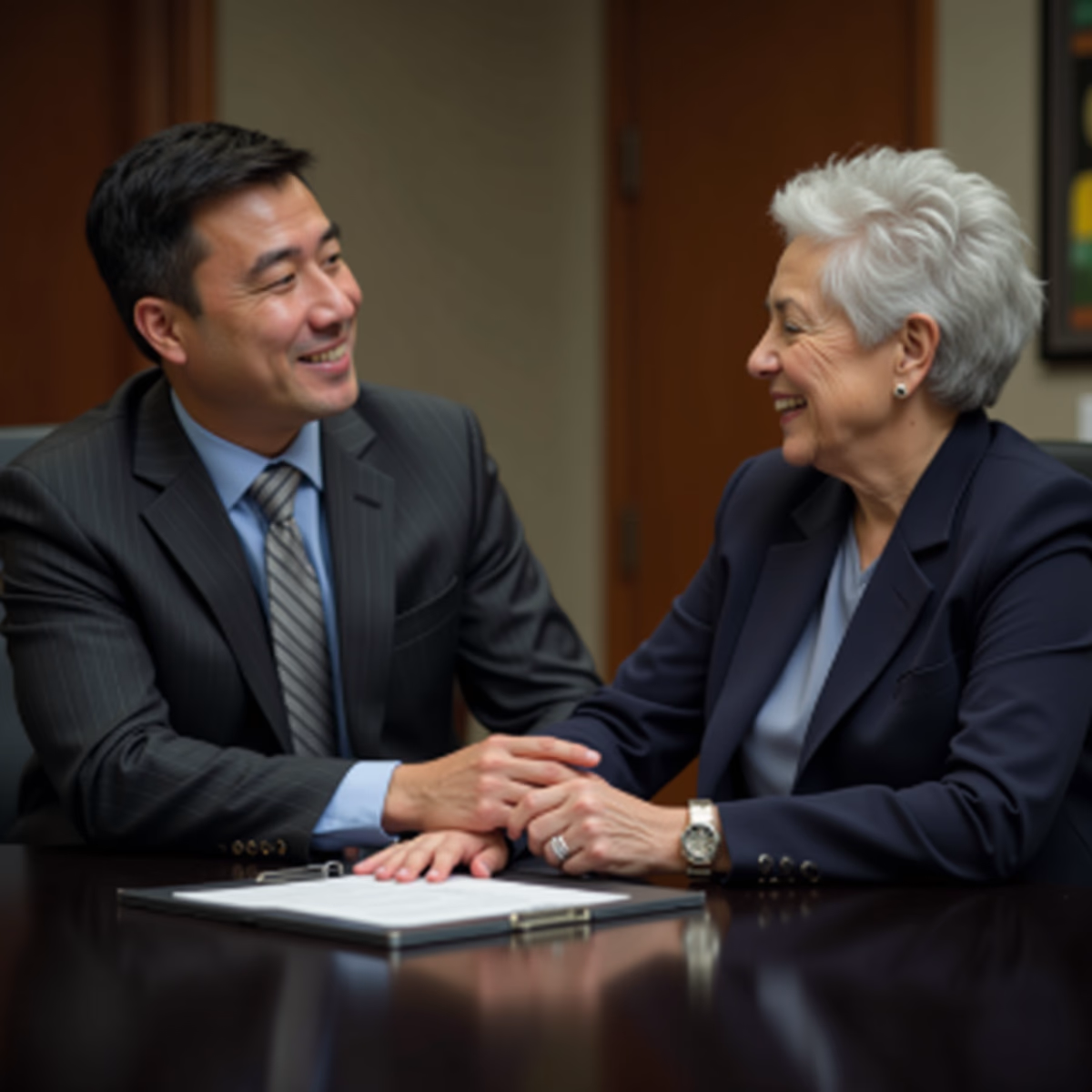
Simply holding land within a trust doesn’t automatically erase capital gains tax. The tax implications depend on how the land is transferred and the specific type of trust used. Direct gifting during your lifetime, even to a trust beneficiary, generally triggers immediate tax consequences if the property’s value exceeds the annual gift tax exclusion. However, strategic use of certain trust structures, particularly Charitable Remainder Trusts (CRTs) and Charitable Lead Trusts (CLTs), can defer or even eliminate capital gains tax liability.
As a CPA as well as an estate planning attorney with over 35 years of experience, I understand the interplay between tax law and estate planning. The key advantage I bring to my clients is the ability to proactively address both aspects simultaneously, maximizing wealth transfer and minimizing tax burdens. We don’t just draft trusts; we engineer tax-efficient solutions.
What’s the Difference Between a CRT and a CLT?
Let’s break down the primary mechanisms. Charitable Remainder Trusts (CRTs) pay income to you or your heirs for a set term, with the remaining assets going to charity. This allows you to bypass capital gains tax on appreciated assets – like that Temecula land – when you transfer it into the CRT. The income stream is taxed as ordinary income, but avoiding the potentially higher capital gains rate can be a significant benefit. Conversely, Charitable Lead Trusts (CLTs) provide an immediate income stream to a charity, preserving the remaining assets for your heirs at a future date. CLTs are particularly useful if you’re comfortable with the charitable contribution now, knowing your family will receive the principal later.
How Does a Trust Transfer Differ From a Direct Sale?
When you directly sell land, you realize the full capital gain at the time of the sale. The gain is calculated as the difference between the sale price and your adjusted cost basis (original purchase price plus improvements). A trust-based transfer, specifically utilizing a CRT, allows you to receive an income stream without immediately triggering that gain. The charitable deduction also reduces your taxable income. However, it’s crucial to remember the rules surrounding deductions, and how they can affect the overall benefit.
What Happens if the Charity Fails?
A legitimate concern is what happens if the charity named in your trust ceases to exist? California courts address this through the Cy Pres Doctrine. This doctrine allows the court to redirect the trust assets to a similar charitable organization, ensuring your philanthropic intent is still fulfilled. However, the trust document should ideally anticipate this possibility and name a successor charity, providing additional clarity.
What About Digital Assets and Cryptocurrency Held for Charitable Giving?
Increasingly, clients hold digital assets like cryptocurrency. Without specific RUFADAA language (Probate Code § 870) in the Charitable Trust, service providers can legally block a trustee from accessing these accounts or cryptocurrency intended for charitable distribution. This is a frequently missed detail that can derail even the best-intentioned charitable plans. We build in these provisions as a matter of course.
What About Real Estate Transfers and AB 2016?
For deaths on or after April 1, 2025, gifting a residence valued up to $750,000 to a charity can qualify for a “Petition for Succession” under AB 2016 (Probate Code § 13151). This is a court-ordered process, a Petition requiring a Judge’s Order – it’s not the same as a simple transfer. Importantly, the decedent’s other non-real estate assets must remain below the $208,850 threshold for this to work. For smaller property values—real property under $69,625—a Small Estate Affidavit may be sufficient, but the AB 2016 route provides more comprehensive protection for larger estates.
What If the Estate Tax Exemption Changes?
The 2026 ‘Sunset’ of the increased estate tax exemption was averted by the OBBBA, ensuring a $15 million per person Federal Estate Tax Exemption effective Jan 1, 2026. This allows high-net-worth donors to leverage charitable trusts for excess value protection while benefiting the community. While the exemption remains generous, strategic planning is still vital, as tax laws are subject to change.
What Oversight Does the Attorney General Have?
Trustees of California charitable trusts are mandated to comply with annual reporting obligations via the Registry of Charitable Trusts under Government Code § 12585, subject to supervision by the Attorney General to prevent self-dealing or mismanagement. Proper record-keeping and adherence to these regulations are essential to maintain the trust’s validity and avoid potential legal issues.
- Label: Understanding the type of trust is crucial for capital gains mitigation.
- Label: CRTs and CLTs offer different approaches to charitable giving and tax benefits.
- Label: AB 2016 provides a specific pathway for transferring real estate to charity, but has limitations.
- Label: RUFADAA provisions are essential for accessing digital assets held in the trust.
- Label: The Cy Pres Doctrine protects your charitable intent even if the designated charity ceases to exist.
What causes California trust administration to fail due to poor funding, vague terms, or trustee misconduct?
Success in trust administration depends on more than just the document; it requires active management of assets, precise accounting to beneficiaries, and careful navigation of tax rules. Whether dealing with a blended family or complex real estate, understanding the mechanics of trust law is the only way to ensure the grantor’s wishes survive scrutiny.
- The Conflict: Prepare for potential trust litigation if terms are vague.
- The Duty: Follow strict trustee duties to avoid liability.
- The Legacy: Create charitable trusts for tax efficiency.
Ultimately, the success of a trust depends on the details—proper funding, clear terms, and a trustee willing to follow the rules. By anticipating friction points and documenting every step of the administration, fiduciaries can protect the estate and themselves from liability.
Verified Authority on California Charitable Trust Administration
-
Business Interest Compliance (FinCEN): FinCEN – Beneficial Ownership Information (BOI)
The Corporate Transparency Act remains in full effect. Trustees managing LLCs (domestic or foreign) within a charitable structure must file a Beneficial Ownership Information (BOI) report. Failure to update control information within 30 days of a change can result in federal civil penalties of $500/day. -
Charitable Trust Formation: California Probate Code § 15200 (Creation of Trust)
This statute governs the legal creation of fiduciary relationships for charitable purposes. It enables donors to support causes—such as education or scientific research—that align with their values through structured giving, ensuring precision and continuity that casual donations lack. -
Digital Asset Access (RUFADAA): California Probate Code § 870 (RUFADAA)
Without specific RUFADAA language (Probate Code § 870) in your Charitable Trust or Will, service providers like Coinbase and Google can legally deny your trustee access to digital assets, potentially stalling the funding of charitable causes. -
Federal Estate Tax Exemption: IRS Estate Tax Guidelines
Reflects the permanent increase to a $15 million per person exemption (effective Jan 1, 2026). This shifts the planning focus for most Californians from tax avoidance to asset protection, but for ultra-high-net-worth estates, charitable trusts remain a primary tool to shield assets above this cap. -
Primary Residence Succession (AB 2016): California Probate Code § 13151 (Petition for Succession)
When transferring property to a charity, you must distinguish between the Small Estate Affidavit (real property <$69,625) and AB 2016. For deaths on or after April 1, 2025, a residence up to $750,000 qualifies for a ‘Petition for Succession’. This is a “Petition” that requires a Judge’s Order, NOT an “Affidavit.” Note that other assets must remain below the $208,850 limit. -
Charitable Tax Exemption (Welfare Exemption): BOE Welfare Exemption (Form 277)
Unlike transfers to children (Prop 19), transferring real estate to a Charitable Trust triggers reassessment unless the property qualifies for the Welfare Exemption. The trustee must file a claim to prove the property is used exclusively for charitable purposes. -
Registry of Charitable Trusts: California Attorney General – Registry of Charitable Trusts
Trustees of charitable trusts must comply with annual reporting obligations under California Government Code § 12585. This resource serves as the oversight portal to ensure proper use of assets and to avoid self-dealing or deviation from the donor’s original intent. -
Small Estate Threshold (Bank Accounts/Cash): California Probate Code § 13100 (Personal Property)
If combined “probate assets” (excluding the AB 2016 residence) exceed $208,850 (as of April 1, 2025), they are subject to formal probate; a Will alone does not allow you to bypass this limit for the purpose of funding a Charitable Trust.
|
Attorney Advertising, Legal Disclosure & Authorship
ATTORNEY ADVERTISING.
This content is provided for general informational and educational purposes only and does not constitute legal, financial, or tax advice. Under the California Rules of Professional Conduct and State Bar advertising regulations, this material may be considered attorney advertising. Reading this content does not create an attorney-client relationship or any professional advisory relationship. Laws vary by jurisdiction and are subject to change, including recent 2026 developments under California’s AB 2016 and evolving federal estate and reporting requirements. You should consult a qualified attorney or advisor regarding your specific circumstances before taking action.
Responsible Attorney:
Steven F. Bliss, California Attorney (Bar No. 147856).
Local Office:
The Law Firm of Steven F. Bliss Esq.43920 Margarita Rd Ste F Temecula, CA 92592 (951) 223-7000
The Law Firm of Steven F. Bliss Esq. is a practice location and trade name used by Steven F. Bliss, Esq., a California-licensed attorney.
About the Author & Legal Review Process
This article was researched and drafted by the Legal Editorial Team of the Law Firm of Steven F. Bliss, Esq.,
a collective of attorneys, legal writers, and paralegals dedicated to translating complex legal concepts into clear, accurate guidance.
Legal Review:
This content was reviewed and approved by Steven F. Bliss, a California-licensed attorney (Bar No. 147856). Mr. Bliss concentrates his practice in estate planning and estate administration, advising clients on proactive planning strategies and representing fiduciaries in probate and trust administration proceedings when formal court involvement becomes necessary.
With more than 35 years of experience in California estate planning and estate administration,
Mr. Bliss focuses on structuring enforceable estate plans, guiding fiduciaries through court-supervised proceedings, resolving creditor and notice issues, and coordinating asset management to support compliant, timely distributions and reduce fiduciary risk. |