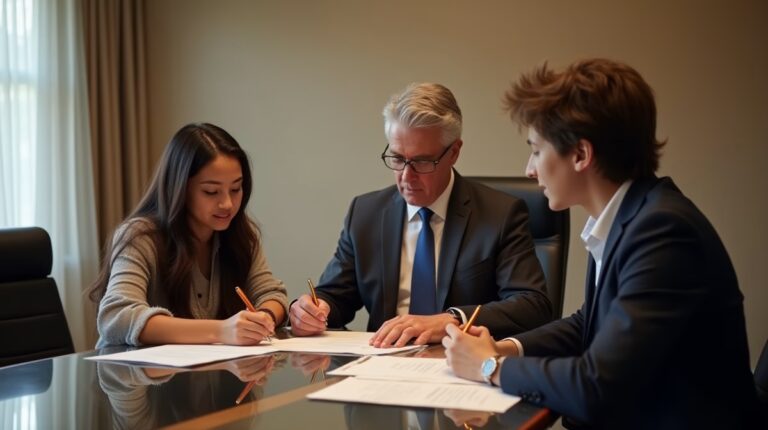
|
Legal & Tax Disclosure
ATTORNEY ADVERTISING.
This article is provided for general informational purposes only and does not constitute legal, financial, or tax advice. Reading this content does not create an attorney-client or professional advisory relationship. Laws vary by jurisdiction and are subject to change. You should consult a qualified professional regarding your specific circumstances. |
Leon was meticulous. He spent months drafting his trust, agonizing over every detail to provide for his children. He had it professionally bound, printed on archival paper, and even designed a custom cover. Then, disaster struck. During a move, the original trust document was lost. Leon remembered signing it in front of his wife, but they hadn’t thought to have it notarized or formally witnessed. Now, proving the validity of the trust—and securing his children’s future—is a costly legal battle.
The question of notarization and witnessing a trust in California is surprisingly nuanced. While a trust itself doesn’t require notarization to be validly created, failing to properly execute it, including adhering to witnessing requirements, can create significant problems down the line, as Leon discovered. It’s a common misconception that simply signing a trust document is enough. California law demands specific procedures to ensure the trust’s enforceability.
What are the signing requirements for a California Trust?

California law doesn’t mandate notarization of the trust document itself. However, it does require the settlor (the person creating the trust) to sign the document in front of two competent witnesses. These witnesses must understand that they are witnessing the settlor’s signature on a trust document and attest to its authenticity. The witnesses should not be beneficiaries of the trust, as that creates a conflict of interest and could invalidate the trust. The goal is to create a clear record of intent and capacity at the time the trust was established.
Does California law require a Notary Public for Trusts?
Although not strictly required for the trust itself, a notarized signature on an accompanying Pour-Over Will is highly recommended, and often practiced. This will ensures that any assets not explicitly titled in the trust at the time of death are “poured over” into the trust for distribution according to its terms. While the trust document itself stands on the witnessing requirement, the will’s notarization provides an extra layer of legal protection and simplifies the probate process if the will is ever challenged. Furthermore, a notarized signature can serve as evidence of the settlor’s capacity at the time of signing, which is crucial if questions arise about mental competence later on.
What happens if a trust isn’t properly witnessed or notarized?
If a trust is not properly signed and witnessed according to California law, it can be challenged in probate court. This challenge could come from disgruntled heirs, creditors, or even the Attorney General if a charitable trust is involved. The court may determine the trust is invalid, meaning assets will be distributed according to California’s intestate succession laws (as if the settlor died without a will or trust), potentially defeating the settlor’s intended wishes. This can lead to lengthy and expensive litigation, as Leon is now experiencing. The burden of proof then shifts to those seeking to enforce the trust, requiring them to present compelling evidence of its validity.
How do I ensure my trust is legally sound in California?
The best way to protect your trust and your beneficiaries is to work with an experienced estate planning attorney. We can guide you through the entire process, ensuring that all signing and witnessing requirements are met, and that the document is legally enforceable. As an estate planning attorney and CPA with over 35 years of experience here in Temecula, I’ve seen firsthand the devastating consequences of improperly executed trusts. My background as a CPA is particularly valuable because I understand the tax implications of different trust structures, including the crucial step-up in basis for assets transferred into a trust, which minimizes capital gains taxes for your heirs. We can tailor a trust strategy to your specific financial situation and goals, maximizing benefits and minimizing potential challenges.
What about digital trust documents and electronic notarization?
The rise of digital estate planning has led to questions about electronic signatures and notarization. While California has adopted laws permitting electronic notarization, it’s essential to ensure that the electronic signature and notarization process comply with all legal requirements. Without specific RUFADAA language (Probate Code § 870) in the Charitable Trust, service providers can legally block a trustee from accessing digital accounts or cryptocurrency intended for charitable distribution. Furthermore, the trustworthiness of the digital signature must be verifiable. We recommend consulting with an attorney to ensure your digital trust documents are fully enforceable.
What if I want to change my trust after it’s been signed?
Trusts are not set in stone. You can amend or revoke your trust at any time during your lifetime, as long as you have the legal capacity to do so. However, any amendments or revocations must also be executed with the same formalities as the original trust document – meaning properly signed and witnessed. Failure to do so can lead to the same problems as an invalidly executed original trust.
How do Charitable Trusts differ from other Trusts?
When establishing a charitable trust, additional requirements come into play. Under California Probate Code §§ 15200–15205, a charitable trust is a fiduciary relationship where property is held for a specific charitable purpose, such as education, scientific research, or community development, requiring written instructions for precision and continuity. Trustees of California charitable trusts are mandated to comply with annual reporting obligations via the Registry of Charitable Trusts under Government Code § 12585, subject to supervision by the Attorney General to prevent self-dealing or mismanagement.
What failures trigger court intervention and contests in California trust administration?
The advantage of a California trust is control and continuity, but this relies entirely on accurate funding and disciplined administration. Without clear asset titles and strict adherence to fiduciary standards, a private trust can quickly become a subject of public litigation over mismanagement, capacity, or undue influence.
A stable trust administration relies on the trustee’s ability to balance investment duties, beneficiary communication, and tax compliance. When these elements are managed proactively, families can avoid the emotional and financial drain of litigation.
Verified Authority on California Charitable Trust Administration
-
Business Interest Compliance (FinCEN): FinCEN – Beneficial Ownership Information (BOI)
The Corporate Transparency Act remains in full effect. Trustees managing LLCs (domestic or foreign) within a charitable structure must file a Beneficial Ownership Information (BOI) report. Failure to update control information within 30 days of a change can result in federal civil penalties of $500/day. -
Charitable Trust Formation: California Probate Code § 15200 (Creation of Trust)
This statute governs the legal creation of fiduciary relationships for charitable purposes. It enables donors to support causes—such as education or scientific research—that align with their values through structured giving, ensuring precision and continuity that casual donations lack. -
Digital Asset Access (RUFADAA): California Probate Code § 870 (RUFADAA)
Without specific RUFADAA language (Probate Code § 870) in your Charitable Trust or Will, service providers like Coinbase and Google can legally deny your trustee access to digital assets, potentially stalling the funding of charitable causes. -
Federal Estate Tax Exemption: IRS Estate Tax Guidelines
Reflects the permanent increase to a $15 million per person exemption (effective Jan 1, 2026). This shifts the planning focus for most Californians from tax avoidance to asset protection, but for ultra-high-net-worth estates, charitable trusts remain a primary tool to shield assets above this cap. -
Primary Residence Succession (AB 2016): California Probate Code § 13151 (Petition for Succession)
When transferring property to a charity, you must distinguish between the Small Estate Affidavit (real property <$69,625) and AB 2016. For deaths on or after April 1, 2025, a residence up to $750,000 qualifies for a ‘Petition for Succession’. This is a “Petition” that requires a Judge’s Order, NOT an “Affidavit.” Note that other assets must remain below the $208,850 limit. -
Charitable Tax Exemption (Welfare Exemption): BOE Welfare Exemption (Form 277)
Unlike transfers to children (Prop 19), transferring real estate to a Charitable Trust triggers reassessment unless the property qualifies for the Welfare Exemption. The trustee must file a claim to prove the property is used exclusively for charitable purposes. -
Registry of Charitable Trusts: California Attorney General – Registry of Charitable Trusts
Trustees of charitable trusts must comply with annual reporting obligations under California Government Code § 12585. This resource serves as the oversight portal to ensure proper use of assets and to avoid self-dealing or deviation from the donor’s original intent. -
Small Estate Threshold (Bank Accounts/Cash): California Probate Code § 13100 (Personal Property)
If combined “probate assets” (excluding the AB 2016 residence) exceed $208,850 (as of April 1, 2025), they are subject to formal probate; a Will alone does not allow you to bypass this limit for the purpose of funding a Charitable Trust.
|
Attorney Advertising, Legal Disclosure & Authorship
ATTORNEY ADVERTISING.
This content is provided for general informational and educational purposes only and does not constitute legal, financial, or tax advice. Under the California Rules of Professional Conduct and State Bar advertising regulations, this material may be considered attorney advertising. Reading this content does not create an attorney-client relationship or any professional advisory relationship. Laws vary by jurisdiction and are subject to change, including recent 2026 developments under California’s AB 2016 and evolving federal estate and reporting requirements. You should consult a qualified attorney or advisor regarding your specific circumstances before taking action.
Responsible Attorney:
Steven F. Bliss, California Attorney (Bar No. 147856).
Local Office:
The Law Firm of Steven F. Bliss Esq.43920 Margarita Rd Ste F Temecula, CA 92592 (951) 223-7000
The Law Firm of Steven F. Bliss Esq. is a practice location and trade name used by Steven F. Bliss, Esq., a California-licensed attorney.
About the Author & Legal Review Process
This article was researched and drafted by the Legal Editorial Team of the Law Firm of Steven F. Bliss, Esq.,
a collective of attorneys, legal writers, and paralegals dedicated to translating complex legal concepts into clear, accurate guidance.
Legal Review:
This content was reviewed and approved by Steven F. Bliss, a California-licensed attorney (Bar No. 147856). Mr. Bliss concentrates his practice in estate planning and estate administration, advising clients on proactive planning strategies and representing fiduciaries in probate and trust administration proceedings when formal court involvement becomes necessary.
With more than 35 years of experience in California estate planning and estate administration,
Mr. Bliss focuses on structuring enforceable estate plans, guiding fiduciaries through court-supervised proceedings, resolving creditor and notice issues, and coordinating asset management to support compliant, timely distributions and reduce fiduciary risk. |