|
Legal & Tax Disclosure
ATTORNEY ADVERTISING.
This article is provided for general informational purposes only and does not constitute legal, financial, or tax advice. Reading this content does not create an attorney-client or professional advisory relationship. Laws vary by jurisdiction and are subject to change. You should consult a qualified professional regarding your specific circumstances. |
Lillian just received a frantic call. Her mother, Beatrice, passed away unexpectedly, and Lillian discovered a handwritten codicil—a change to Beatrice’s will—tucked inside a cookbook. It revoked a substantial gift to Lillian’s brother and left everything to a local animal shelter. When Lillian tried to submit it to the Riverside Probate Court, the executor, her brother, vehemently objected, claiming the codicil wasn’t valid and that Beatrice was likely medicated when she signed it. Now Lillian faces legal fees potentially exceeding $15,000 just to prove the codicil’s authenticity. This scenario, unfortunately, plays out far too often.
The Riverside Probate Court, like all California courts, operates on evidence. While a will or trust document is the starting point, its acceptance isn’t automatic. The court needs corroboration—proof that the document reflects the decedent’s true intentions and was properly executed. Here’s a breakdown of the key evidence the court examines, categorized for clarity.
What Constitutes a Validly Executed Will or Trust?
The most common battles center around whether the will or trust meets the legal requirements for execution. California Probate Code Sections 6110-6113 outline the requirements for wills, and similar provisions exist for trusts. These typically involve:
Signature: The document must be signed by the testator (the person making the will) or the trustor (the person creating the trust).
Witnesses: For wills, two disinterested witnesses must sign the document, attesting they saw the testator sign and believed they were of sound mind. Trust requirements vary depending on the type of trust.
Date: The document should be dated, establishing a clear timeline.
Capacity: The testator or trustor must have been of sound mind—understanding the nature of the act, the extent of their property, and their relationship to those benefiting from the estate.
Evidence supporting these elements includes witness testimony, notary acknowledgments (if applicable), and the document itself. However, even a perfectly executed document can be challenged if issues of undue influence or fraud arise.
How Does the Court Assess Undue Influence?
Undue influence is a major concern in probate litigation. It occurs when someone exerts such control over the testator that the will or trust doesn’t reflect their wishes, but the influencer’s. The court looks for several red flags:
- Confidential Relationship: Was the influencer a caregiver, attorney, or close friend who had significant access and control over the decedent?
- Weakened Condition: Was the decedent frail, ill, or mentally vulnerable at the time the document was created?
- Beneficiary Involvement: Was the influencer also a major beneficiary of the will or trust?
- Suspicious Circumstances: Did the influencer isolate the decedent from family and friends? Did they rush the estate planning process?
- Unnatural Disposition: Does the will or trust deviate significantly from the decedent’s prior estate plans or expressed intentions?
Proving undue influence is difficult. The burden of proof rests on the party alleging it. Evidence might include medical records demonstrating diminished capacity, emails or letters revealing manipulation, and testimony from those who knew the decedent.
What About Challenges to Trust Validity – Specifically, the “Trustee’s Duties”?
Trusts, while often more complex than wills, are also subject to scrutiny. One common area of challenge involves the trustee’s duties. The trustee has a fiduciary responsibility to administer the trust in good faith, for the benefit of the beneficiaries. Evidence the court will consider includes:
Accountings: Trustees are required to provide detailed accountings of all income, expenses, and distributions.
Investment Records: Documentation of how trust assets were invested and managed.
Communication with Beneficiaries: Evidence of transparency and regular communication with beneficiaries.
Conflicts of Interest: Any potential conflicts of interest the trustee may have had.
If a beneficiary alleges the trustee breached their duties—perhaps by self-dealing, mismanagement, or failing to distribute assets properly—the court will examine these records carefully.
The CPA Advantage: Uncovering the Full Financial Picture
As an Estate Planning Attorney and CPA with over 35 years of experience, I often find that disputes arise not from malicious intent, but from a lack of clear understanding of the decedent’s financial affairs. A CPA’s perspective is invaluable. We’re trained to analyze financial records, identify unusual transactions, and determine the true value of assets. This is particularly crucial when dealing with:
Step-Up in Basis: Properly valuing assets at the date of death is critical for minimizing capital gains taxes for the heirs.
Complex Assets: Business interests, real estate holdings, and intellectual property require specialized valuation expertise.
Hidden Assets: A thorough forensic accounting can uncover assets the family may not have been aware of.
The court will give significant weight to an expert CPA’s analysis, helping to establish a fair and accurate accounting of the estate.
What Evidence Specifically Supports a Codicil or Amendment?
Returning to Lillian’s situation, proving the validity of that handwritten codicil is paramount. The court will likely focus on:
Authentication of Handwriting: A forensic handwriting expert can compare the signature on the codicil to known samples of Beatrice’s handwriting.
Witness Testimony: If anyone witnessed Beatrice sign the codicil, their testimony would be crucial.
Documentary Evidence: Any notes, letters, or emails mentioning Beatrice’s intention to change her will or trust.
Contextual Evidence: Establishing Beatrice’s state of mind at the time she signed the codicil. Was she clear-headed and coherent? Was she acting voluntarily?
It’s important to note that for deaths on or after April 1, 2025, a Petition for Succession under AB 2016 (Probate Code § 13151) may be available for a primary residence valued up to $750,000, but only if the decedent’s other assets remain below the $208,850 Small Estate limit. This is distinct from the Small Estate Affidavit which applies to real property under $69,625.
I’ve also seen many cases where disputes arise due to assumptions about residency. Remember, spending less than 183 days in California does not automatically terminate residency; the FTB uses the ‘Closest Connection’ test (evaluating 19 factors like your primary doctor and social ties) to determine domicile. The FTB will use Form 4600 (Residency Questionnaire) to scrutinize a decedent’s life, including the location of their dentist, the registration of their pets, and where they keep their safe deposit boxes.
What makes a California will legally enforceable when it matters most?
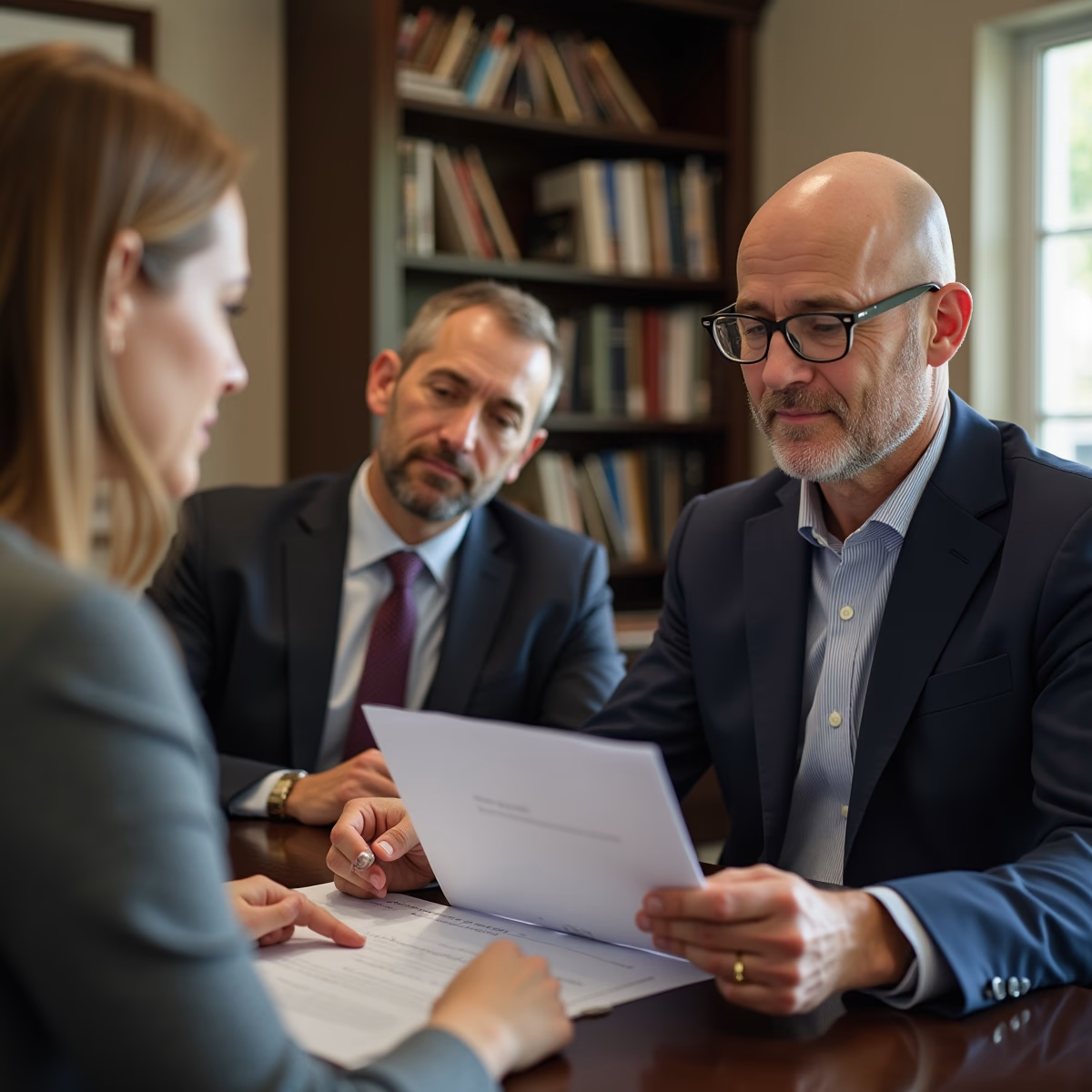
In California, a last will and testament is reviewed under probate standards that focus on intent, capacity, and execution. Clear drafting reduces ambiguity, limits misinterpretation, and helps families avoid unnecessary conflict during estate administration.
- Ambiguity: Avoid vague terms that trigger interpretation fights.
- Health: verify legal capacity at signing.
- Omissions: check for codicils often.
When a will is drafted with California probate review in mind, it becomes a stabilizing roadmap rather than a source of conflict. Clear intent, proper authority, and compliant execution protect both families and estates.
Controlling Legal Standards for Establishing Domicile and Residency
-
Residency Guidelines: FTB Pub 1031 (Guidelines for Determining Resident Status)
This is the primary resource for the “Closest Connection” test. In 2026, it details how the FTB evaluates 19 factors—including the location of your healthcare providers and social ties—to determine if your presence in the state is “permanent” or merely “transitory.” -
Voter Registration: California Secretary of State – Voter Registration
Updating your voting address is a critical indicator of intent. For the June 2, 2026, Primary Election, the deadline to register online is May 18, 2026. This serves as a public declaration of your primary home. -
Federal Estate Tax: IRS Estate Tax Overview
While domicile determines state tax, this resource outlines federal guidelines. It reflects the permanent federal estate tax exemption of $15 million per person ($30 million for couples), effective Jan 1, 2026. -
Proof of Residency: California DMV – REAL ID Checklist
Since the federal enforcement deadline passed in 2025, a REAL ID is mandatory for domestic flights. This page lists the specific residency documents (e.g., utility bills, tax returns) that the state accepts as proof of a permanent California address.
|
Attorney Advertising, Legal Disclosure & Authorship
ATTORNEY ADVERTISING.
This content is provided for general informational and educational purposes only and does not constitute legal, financial, or tax advice. Under the California Rules of Professional Conduct and State Bar advertising regulations, this material may be considered attorney advertising. Reading this content does not create an attorney-client relationship or any professional advisory relationship. Laws vary by jurisdiction and are subject to change, including recent 2026 developments under California’s AB 2016 and evolving federal estate and reporting requirements. You should consult a qualified attorney or advisor regarding your specific circumstances before taking action.
Responsible Attorney:
Steven F. Bliss, California Attorney (Bar No. 147856).
Local Office:
The Law Firm of Steven F. Bliss Esq.43920 Margarita Rd Ste F Temecula, CA 92592 (951) 223-7000
The Law Firm of Steven F. Bliss Esq. is a practice location and trade name used by Steven F. Bliss, Esq., a California-licensed attorney.
About the Author & Legal Review Process
This article was researched and drafted by the Legal Editorial Team of the Law Firm of Steven F. Bliss, Esq.,
a collective of attorneys, legal writers, and paralegals dedicated to translating complex legal concepts into clear, accurate guidance.
Legal Review:
This content was reviewed and approved by Steven F. Bliss, a California-licensed attorney (Bar No. 147856). Mr. Bliss concentrates his practice in estate planning and estate administration, advising clients on proactive planning strategies and representing fiduciaries in probate and trust administration proceedings when formal court involvement becomes necessary.
With more than 35 years of experience in California estate planning and estate administration,
Mr. Bliss focuses on structuring enforceable estate plans, guiding fiduciaries through court-supervised proceedings, resolving creditor and notice issues, and coordinating asset management to support compliant, timely distributions and reduce fiduciary risk. |