
|
Legal & Tax Disclosure
ATTORNEY ADVERTISING.
This article is provided for general informational purposes only and does not constitute legal, financial, or tax advice. Reading this content does not create an attorney-client or professional advisory relationship. Laws vary by jurisdiction and are subject to change. You should consult a qualified professional regarding your specific circumstances. |
I recently spoke with Kirk, a client who thought he’d done everything right. He’d created a trust years ago, even adding a “pour-over will” as we recommended. Unfortunately, Kirk passed away unexpectedly, and his daughter discovered that over $350,000 remained in his original checking and savings accounts – assets that hadn’t been transferred into the trust. Now, his family faces the added expense and delay of a court-supervised probate just to transfer these overlooked funds, a situation easily avoided with proper funding. It’s a heartbreaking example of how meticulous estate planning can be undone by a failure to execute the final, crucial step: actual funding.
What Does “Funding” a Trust Actually Mean?
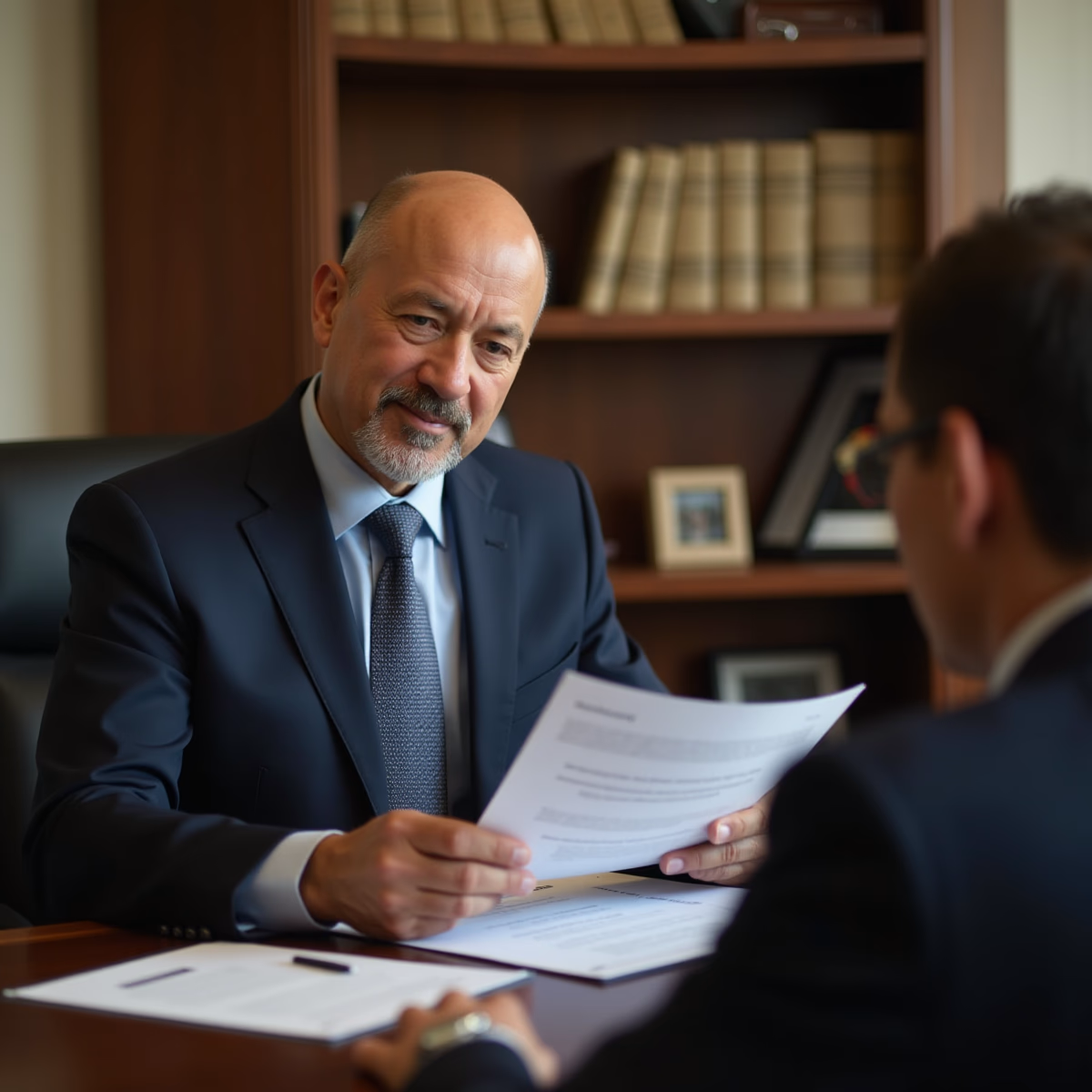
Creating a trust document is only half the battle. The trust itself is an empty vessel until you formally transfer ownership of your assets into it. This means retitling accounts, deeds, and investment accounts in the name of the trust. Many people mistakenly believe that simply naming the trust in their will is enough, but a will only controls assets that haven’t already been titled in the trust’s name. Think of it like this: the trust needs a legal “address” for all its holdings, and that’s achieved through proper titling.
How Do I Transfer Bank Accounts?
The process for funding bank accounts is relatively straightforward, but requires direct action. You can’t just hope the bank knows about your trust. Here are the key steps:
- Request New Account Forms: Contact your bank and request the forms necessary to change the ownership of your accounts. These forms often vary by institution, so don’t hesitate to ask for guidance.
- Complete the Forms Accurately: The new account forms will require you to list the trustee(s) of your trust as the new owner(s). Be meticulous with names and trust dates. Errors can cause delays or rejections.
- Provide a Certified Copy of the Trust Document: Banks will almost always require a certified copy of your trust document to verify the trustee’s authority and the trust’s validity. This ensures they’re dealing with a legally recognized entity.
- Signature Requirements: Often, both the current account holder(s) and the trustee(s) will need to sign the new account forms. Be prepared to visit the bank in person with all parties present.
What Happens if I Forget to Fund an Account?
This is where Kirk’s situation becomes all too common. If an asset was listed on a Schedule A to your trust but never legally titled in the trust’s name, you may need to file a Heggstad Petition under Probate Code § 850 to ask a judge to retroactively ‘fund’ the asset without a full probate, though this is not guaranteed. A pour-over will directs any assets not already in the trust to “pour over” into it at your death, but that requires a probate proceeding, defeating the primary purpose of having a trust in the first place.
What About Payable on Death (POD) Designations?
While retitling accounts is the most secure method, a Payable on Death (POD) designation can provide a simplified alternative for smaller amounts. This allows funds to pass directly to your beneficiary upon your death, bypassing probate. However, relying solely on POD designations is risky. If the beneficiary predeceases you, or if there’s a dispute over the beneficiary’s identity, the funds could still end up in probate. Furthermore, if cash accounts left out of the trust exceed $208,850 (effective April 1, 2025), a ‘pour-over will’ alone is insufficient to avoid probate; these assets must be retitled or have a ‘Payable on Death’ (POD) designation to bypass court.
How Does My CPA Background Help with Trust Funding?
As an attorney and a CPA with over 35 years of experience, I bring a unique perspective to estate planning. Properly funding a trust isn’t just about legal paperwork; it’s about understanding the tax implications. For instance, understanding the basis of assets transferred into the trust is crucial for minimizing capital gains taxes for your beneficiaries. We also address the implications of Prop 19 rules are strict regarding parent-child transfers; funding a trust incorrectly can accidentally trigger a reassessment to current market value if the beneficiary does not live in the home. My CPA expertise allows me to structure your trust and funding process to optimize both estate tax benefits and income tax planning for your heirs.
What separates a successful California trust distribution from a costly battle over interpretation and accounting?
California trusts are designed to bypass probate and maintain privacy, yet they often fail when assets are not properly funded, trustee duties are ignored, or ambiguous terms trigger disputes. Even with a signed trust document, families can face court battles if the “operations manual” of the trust isn’t followed strictly under the Probate Code.
| Tax Strategy | Solution |
|---|---|
| Grandchildren | Use a GST tax planning. |
| Annuities | Setup a GRAT. |
| Residence | Leverage a qualified personal residence trust. |
Ultimately, the success of a trust depends on the details—proper funding, clear terms, and a trustee willing to follow the rules. By anticipating friction points and documenting every step of the administration, fiduciaries can protect the estate and themselves from liability.
Verified Authority on California Trust Funding & Asset Assignment
-
Trust Property Requirement: California Probate Code § 15200
The fundamental statute stating that a trust only exists if it holds property. This is the legal basis for why executing a deed or changing a bank account title is mandatory, not optional. -
Remedying Failed Funding (Heggstad): California Probate Code § 850 (Heggstad Petition)
If an asset was intended for the trust (listed on Schedule A) but never formally transferred, this code allows for a petition to claim the property for the trust without a full probate administration. -
Primary Residence “Backup” (AB 2016): California Probate Code § 13151 (Petition for Succession)
Effective April 1, 2025, if a primary residence worth $750,000 or less was accidentally left out of the trust, this “Petition for Succession” serves as a faster, cheaper alternative to full probate funding errors. -
Property Tax Reassessment (Prop 19): California State Board of Equalization (Prop 19)
Essential reading before funding real estate. While transfers into a revocable trust generally don’t trigger reassessment, the ultimate distribution to children might under strict Prop 19 primary residence rules. -
Small Estate Threshold (Cash/Personal Property): California Probate Code § 13100
Defines the $208,850 limit (effective April 1, 2025) for non-real estate assets. If “forgotten” accounts exceed this amount, they cannot be collected via affidavit and may require formal probate to pour them into the trust. -
Digital Asset Funding (RUFADAA): California Probate Code § 870 (RUFADAA)
Without specific funding language or a “digital schedule,” service providers like Google or Coinbase can legally deny your trustee access. This statute provides the legal mechanism to “fund” digital access into your trust.
|
Attorney Advertising, Legal Disclosure & Authorship
ATTORNEY ADVERTISING.
This content is provided for general informational and educational purposes only and does not constitute legal, financial, or tax advice. Under the California Rules of Professional Conduct and State Bar advertising regulations, this material may be considered attorney advertising. Reading this content does not create an attorney-client relationship or any professional advisory relationship. Laws vary by jurisdiction and are subject to change, including recent 2026 developments under California’s AB 2016 and evolving federal estate and reporting requirements. You should consult a qualified attorney or advisor regarding your specific circumstances before taking action.
Responsible Attorney:
Steven F. Bliss, California Attorney (Bar No. 147856).
Local Office:
The Law Firm of Steven F. Bliss Esq.43920 Margarita Rd Ste F Temecula, CA 92592 (951) 223-7000
The Law Firm of Steven F. Bliss Esq. is a practice location and trade name used by Steven F. Bliss, Esq., a California-licensed attorney.
About the Author & Legal Review Process
This article was researched and drafted by the Legal Editorial Team of the Law Firm of Steven F. Bliss, Esq.,
a collective of attorneys, legal writers, and paralegals dedicated to translating complex legal concepts into clear, accurate guidance.
Legal Review:
This content was reviewed and approved by Steven F. Bliss, a California-licensed attorney (Bar No. 147856). Mr. Bliss concentrates his practice in estate planning and estate administration, advising clients on proactive planning strategies and representing fiduciaries in probate and trust administration proceedings when formal court involvement becomes necessary.
With more than 35 years of experience in California estate planning and estate administration,
Mr. Bliss focuses on structuring enforceable estate plans, guiding fiduciaries through court-supervised proceedings, resolving creditor and notice issues, and coordinating asset management to support compliant, timely distributions and reduce fiduciary risk. |