
This article is provided for general informational purposes only and does not constitute legal, financial, or tax advice.
Reading this content does not create an attorney-client or professional advisory relationship.
Laws vary by jurisdiction and are subject to change. You should consult a qualified professional regarding your specific circumstances.
Bruce received a trust distribution check for $15,000, but he suspected his mother’s trust was significantly larger—including a valuable beach house she’d always talked about. He felt shut out and didn’t know what else the trust held, or if the trustee was acting in everyone’s best interest. The resulting family conflict cost him over $20,000 in legal fees just to get basic information.
As a Temecula estate planning attorney and CPA with over 35 years of experience, I often encounter beneficiaries in situations like Bruce’s. They’ve received a partial distribution, or heard whispers of assets, but lack transparency into the complete picture of the trust’s holdings. California law provides beneficiaries with significant rights to information, but understanding the specifics can be crucial to protecting your inheritance.
What Information Am I Entitled to Receive as a Trust Beneficiary?
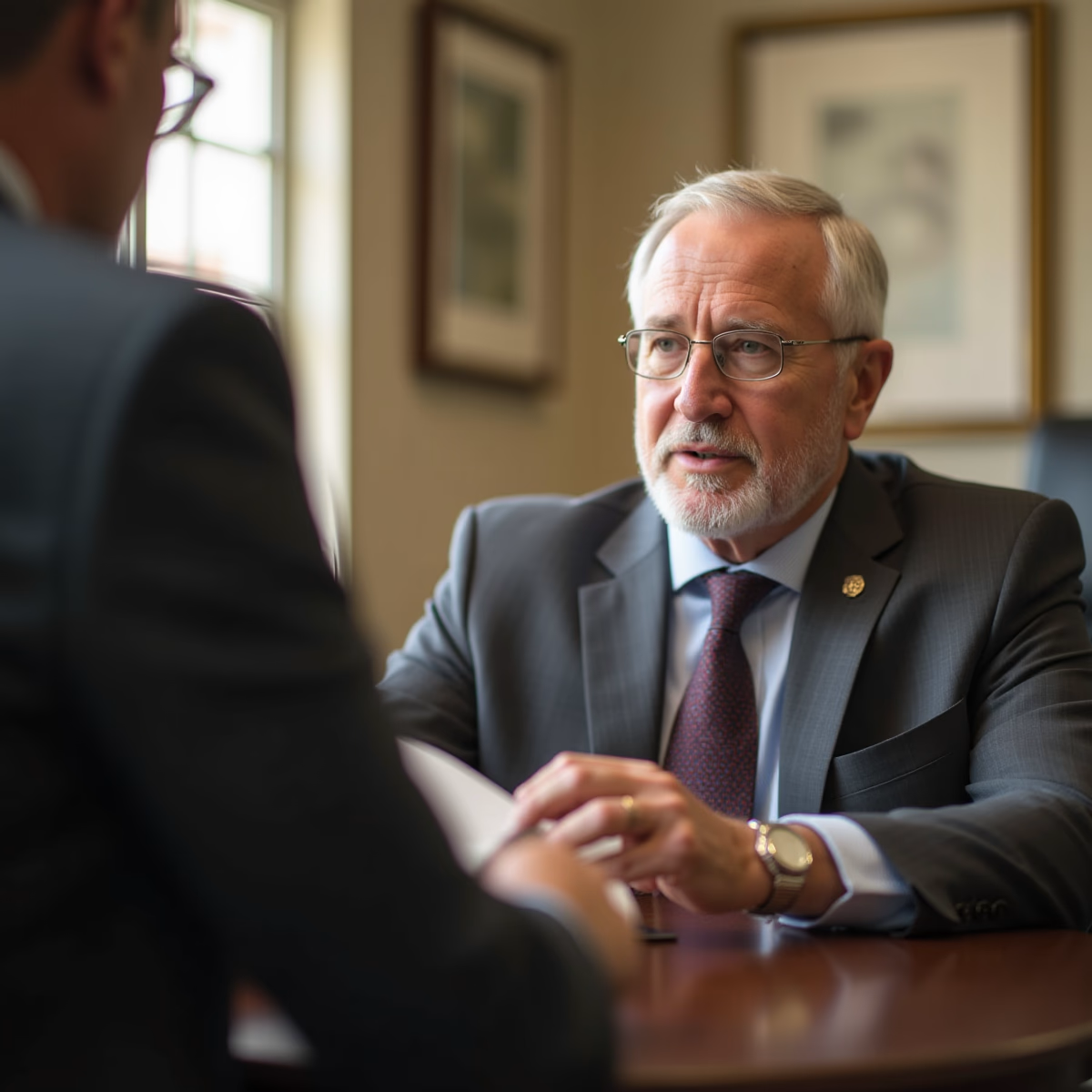
Beneficiaries aren’t simply entitled to a lump sum check and silence. You have the legal right to be “reasonably informed” about the trust’s administration. This includes a general overview of the assets held within the trust, how they are being managed, and the trustee’s actions. However, the extent of this right isn’t unlimited. The trustee isn’t obligated to provide every minute detail or anticipate every question you might have.
How Do I Formally Request Information from the Trustee?
The first step is a written request. It’s best to send it via certified mail, return receipt requested, to create a documented record. Be specific about the information you seek – avoid vague demands like “everything.” Ask for specific asset categories (real estate, stocks, bonds, etc.) or time periods. A well-crafted request is more likely to receive a comprehensive response.
What if the Trustee Refuses to Provide an Accounting?
This is where the legal muscle comes into play. Under Probate Code § 16060 & § 16062, trustees have an affirmative duty to provide a formal accounting, typically annually. If a trustee refuses to comply, you have recourse. You can petition the court to compel the trustee to provide an accounting. More importantly, you can potentially surcharge the trustee – meaning they can be held personally liable for any losses resulting from their failure to provide information or improper administration.
Can I Demand a Complete List of All Assets, Even Those Not Currently Generating Income?
Yes, within reason. While the trustee isn’t required to produce documents that are clearly irrelevant, you are entitled to know about all assets held by the trust, even those that may be temporarily illiquid or not producing income. This is especially important if you suspect mismanagement or that assets are being hidden. The scope of permissible inquiry is a balancing act – the court will consider the burden on the trustee versus the beneficiary’s legitimate need to know.
What About Assets That Were Supposed to Be in the Trust, But Aren’t Showing Up?
Sometimes, assets are listed on the original trust schedule but were never formally transferred into the trust’s ownership. This is surprisingly common. For example, a house might be listed, but the deed never changed. In these cases, you can utilize the Heggstad Petition (Probate Code § 850). This allows you to petition the court to confirm these assets as belonging to the trust, preventing them from becoming subject to probate as separate property.
Is There a Time Limit to Request Information?
While there isn’t a strict deadline for requesting general information, it’s critical to act promptly. If you suspect wrongdoing, delays can weaken your position. Furthermore, remember the 120-day window stipulated in Probate Code § 16061.7 for contesting the trust terms following formal notification. A “copy of the trust” is not the same as the formal statutory notice required to start the clock. The 120-day period begins when the formal notification is served.
My experience as both an attorney and a CPA gives me a unique perspective on trust administration. Understanding the tax implications – particularly the potential for a step-up in basis and avoiding capital gains – is just as important as knowing what assets are held. Proper valuation and asset titling are crucial to maximizing the benefit of the trust for you and your family.
How do enforcement rules in California probate court shape outcomes for heirs and fiduciaries?
California probate is designed to provide court-supervised transfer of property, yet cases often break down when authority is unclear, required steps are missed, or disputes arise over assets, notice, and fiduciary conduct. When the process is misunderstood, families can face avoidable delay, escalating conflict, and increased exposure to creditor issues, hearings, or litigation before the estate can close.
To manage the estate’s value, separate property types by learning probate assets, confirm exclusions through assets that bypass probate, and support valuation steps with probate inventory requirements to reduce disagreements about what is in the estate.
A stable probate administration outcome usually follows from clarity, consistency, and readiness for court review, especially when multiple stakeholders and competing interpretations are involved. When documentation supports enforcement and timelines are respected, families are less likely to face preventable escalation.
Verified Authority on California Probate Alternatives
-
Personal Property Affidavit ($208,850 Limit): California Probate Code § 13100 (Small Estate Affidavit)
For deaths on or after April 1, 2025, the gross value threshold for using a Small Estate Affidavit has increased to $208,850. This procedure allows successors to collect cash, stocks, and personal items without court involvement. Warning: This total MUST NOT include assets held in joint tenancy, trust, or named beneficiaries (POD/TOD), but MUST generally include the value of all real property in the estate. -
Primary Residence Succession (AB 2016): California Probate Code § 13151 (Petition for Succession)
You must distinguish between the Affidavit for Real Property of Small Value (strictly for property <$69,625) and AB 2016. Under AB 2016, a primary residence valued up to $750,000 qualifies for a ‘Petition for Succession’ rather than full probate. This is a court-filed Petition requiring a Judge’s Order, though it is significantly faster than full administration. -
Spousal Property Petition (Unlimited): California Probate Code § 13650 (Spousal Transfers)
This powerful alternative allows for the transfer of unlimited assets to a surviving spouse or domestic partner without full probate administration. It applies to any asset passing to the spouse, whether characterized as community property, quasi-community property, or separate property (via Will). -
Trust Assets & The “Heggstad” Petition: California Probate Code § 850 (Heggstad Petition)
If a decedent intended an asset to be in their trust (e.g., listed on Schedule A) but failed to retitle it (the “Oops” factor), a Section 850 Petition can obtain a court order confirming the asset as trust property. This “cures” the title defect and avoids opening a full probate estate for that single asset. -
Vacant Land & Timeshares: California Probate Code § 13200 (Real Property of Small Value)
For real property interests valued at less than $69,625 (the 2025/2026 adjusted limit), successors can file an Affidavit for Real Property of Small Value with the Court Clerk and record a certified copy with the County Recorder. This completely bypasses the need for a hearing or judge’s order. -
Vehicle & Vessel Transfers (DMV): DMV Form REG 5 (Affidavit for Transfer Without Probate)
Vehicles and vessels may be transferred outside of probate using the Affidavit for Transfer Without Probate (REG 5). Critically, the value of the vehicle is excluded from the $208,850 small estate calculation, meaning a high-value car does not disqualify an estate from using summary procedures. -
Digital Asset Access (RUFADAA): California Probate Code § 870 (RUFADAA)
Even in summary administration, digital assets can be locked. Without specific RUFADAA language (Probate Code § 870) in your Will or Trust, service providers like Coinbase and Google can legally deny successors access to digital wallets and accounts, forcing a full probate just to retrieve them.
|
Attorney Advertising, Legal Disclosure & Authorship
ATTORNEY ADVERTISING.
This content is provided for general informational and educational purposes only and does not constitute legal, financial, or tax advice. Under the California Rules of Professional Conduct and State Bar advertising regulations, this material may be considered attorney advertising. Reading this content does not create an attorney-client relationship or any professional advisory relationship. Laws vary by jurisdiction and are subject to change, including recent 2026 developments under California’s AB 2016 and evolving federal estate and reporting requirements. You should consult a qualified attorney or advisor regarding your specific circumstances before taking action.
Responsible Attorney:
Steven F. Bliss, California Attorney (Bar No. 147856).
Local Office:
The Law Firm of Steven F. Bliss Esq.43920 Margarita Rd Ste F Temecula, CA 92592 (951) 223-7000
The Law Firm of Steven F. Bliss Esq. is a practice location and trade name used by Steven F. Bliss, Esq., a California-licensed attorney.
About the Author & Legal Review Process
This article was researched and drafted by the Legal Editorial Team of the Law Firm of Steven F. Bliss, Esq.,
a collective of attorneys, legal writers, and paralegals dedicated to translating complex legal concepts into clear, accurate guidance.
Legal Review:
This content was reviewed and approved by Steven F. Bliss, a California-licensed attorney (Bar No. 147856). Mr. Bliss concentrates his practice in estate planning and estate administration, advising clients on proactive planning strategies and representing fiduciaries in probate and trust administration proceedings when formal court involvement becomes necessary.
With more than 35 years of experience in California estate planning and estate administration,
Mr. Bliss focuses on structuring enforceable estate plans, guiding fiduciaries through court-supervised proceedings, resolving creditor and notice issues, and coordinating asset management to support compliant, timely distributions and reduce fiduciary risk. |