
This article is provided for general informational purposes only and does not constitute legal, financial, or tax advice.
Reading this content does not create an attorney-client or professional advisory relationship.
Laws vary by jurisdiction and are subject to change. You should consult a qualified professional regarding your specific circumstances.
Randy called me in a panic last week. His father had passed unexpectedly, and Randy was the named beneficiary on a 401(k) account worth nearly $350,000. But his father, bless his heart, had been meticulous about some estate planning, and sloppy about others. He had a will, but it hadn’t been updated in twenty years, and worse, he’d attempted a codicil – handwritten on a napkin, witnessed improperly, and ultimately unusable. Now, Randy faced the prospect of a full probate to access those crucial funds, potentially costing his family tens of thousands in legal fees and delaying distribution for a year or more. A simple oversight with a beneficiary designation could derail even the best-laid plans, and it’s a surprisingly common situation.
What Happens to 401(k)s When Someone Dies?
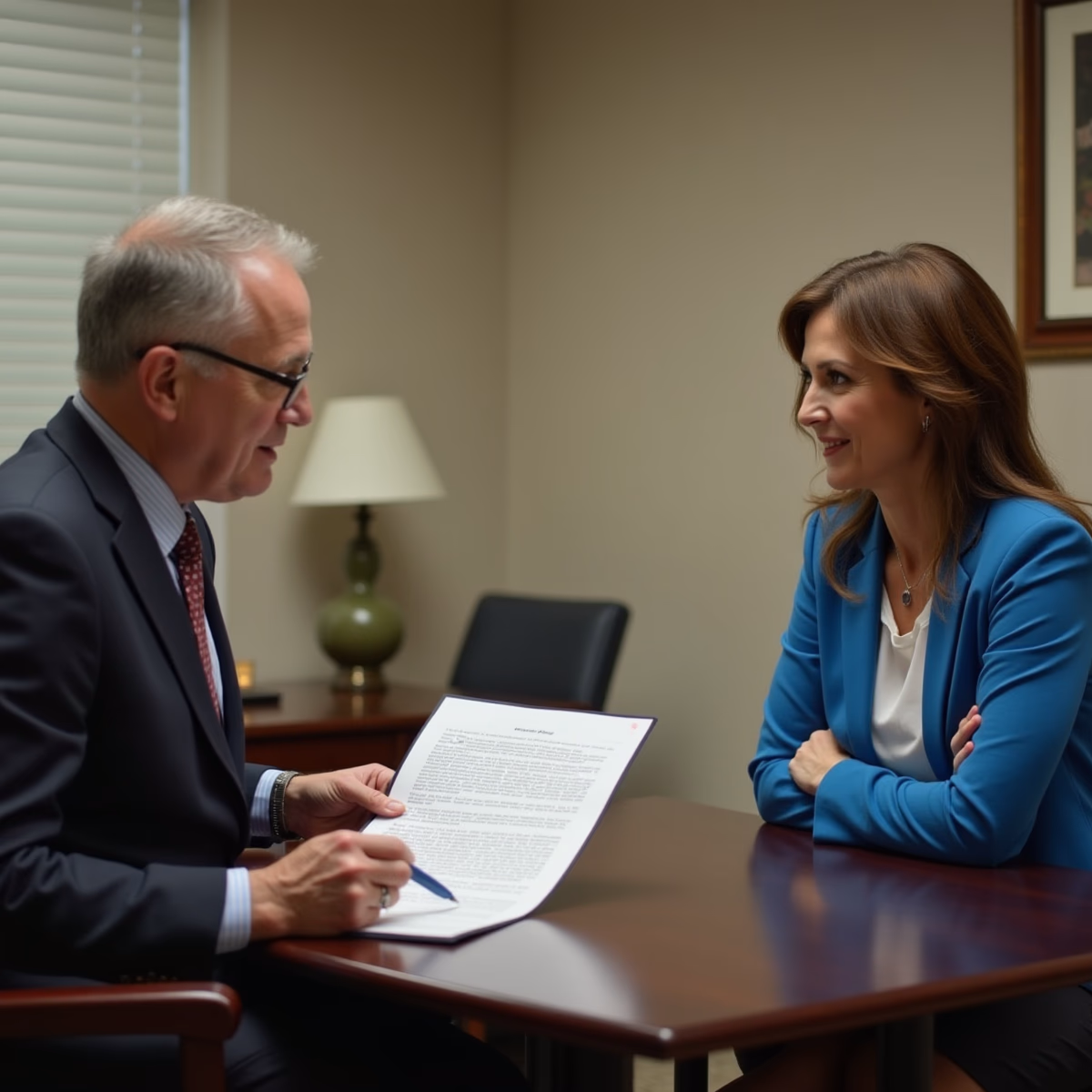
Generally, 401(k) plans are designed to bypass probate entirely. This is one of the primary benefits of retirement accounts. Unlike assets held solely in your name without a designated beneficiary, a 401(k) (or IRA, for that matter) passes directly to the named beneficiary according to the plan’s rules. This is a powerful tool in estate planning, but it hinges on proper beneficiary designations. The plan administrator will require a death certificate and beneficiary documentation to facilitate the transfer.
Are 401(k)s Considered Part of the Probate Estate?
No, a properly designated 401(k) is not considered part of the probate estate. However, the critical word is “properly.” If there is no beneficiary designated, or if the beneficiary is deceased, the funds will likely be subject to probate as if they were any other asset in the estate. That’s where Randy found himself. His father’s outdated will didn’t override the lack of a valid beneficiary on the 401(k) itself. This can lead to significant delays and expenses.
What if There’s No Beneficiary Listed on the 401(k)?
This is where things get complicated and potentially expensive. If no beneficiary is listed, the 401(k) assets become part of the probate estate. This means the assets are subject to the probate process, including inventory, appraisal, creditor claims, and ultimately, distribution according to the will (or state intestacy laws if there is no will). As I explained to Randy, probate in California isn’t cheap or quick.
Can a Surviving Spouse Simply Roll Over the 401(k)?
Often, yes. A surviving spouse generally has the option to roll over the deceased’s 401(k) into their own IRA or 401(k) account, providing continued tax-deferred growth. This is often the simplest and most tax-efficient solution. However, depending on the specific plan rules, there might be timing requirements for the rollover. This is also a good time to revisit their own estate plan to ensure everything aligns.
What About Beneficiary Designations and Trusts?
Naming a trust as a beneficiary of a 401(k) can be a powerful estate planning strategy. It allows you to maintain control over the distribution of the funds, even after your death, and can provide asset protection for your beneficiaries. However, the trust document must comply with the 401(k) plan rules. Some plans require a “see-through” trust, meaning the beneficiaries of the trust must be identifiable.
What is the Role of a CPA in 401(k) Estate Planning?
As both an Estate Planning Attorney and a CPA with over 35 years of experience, I can tell you this is where the advantage truly lies. Understanding the tax implications of 401(k) distributions is crucial. A CPA can advise on the best way to distribute the funds to minimize income taxes for the beneficiaries. For example, the concept of “step-up in basis” doesn’t apply to retirement accounts; distributions are generally taxed as ordinary income. However, strategic planning can mitigate the tax burden and preserve more of the inheritance. Proper valuation of the account at the date of death is also essential for estate tax purposes.
What Happens if a Beneficiary Dies Before the 401(k) Owner?
This is a surprisingly common scenario. Most 401(k) plans have contingent beneficiary provisions. If the primary beneficiary dies before the account owner, the funds will typically pass to the contingent beneficiary. If there’s no contingent beneficiary, it can again fall into probate. It’s crucial to regularly review and update your beneficiary designations to reflect life changes, such as the death of a beneficiary.
What About Small Estate Procedures and 401(k)s?
Even if the overall estate is small enough to qualify for a simplified probate procedure, such as the Section 13100 Affidavit for deaths occurring on or after April 1, 2025, the gross value threshold for using a Small Estate Affidavit (Probate Code § 13100) has increased to $208,850. This procedure allows successors to collect personal property without court involvement. However, 401(k)s are often handled outside of these procedures, directly by the plan administrator, regardless of the estate size. This is because the account is governed by ERISA, federal law that supersedes many state probate rules. It’s important to remember this total MUST NOT include assets held in joint tenancy, trust, or those with named beneficiaries (POD/TOD), but MUST include the value of any real property unless that property is handled via a separate summary procedure.
- Proper Beneficiary Designation: The most important step.
- Regular Review: Update designations after life changes (marriage, divorce, births, deaths).
- Trust Considerations: Explore using a trust for greater control and asset protection.
- Tax Planning: Work with a CPA to minimize income tax on distributions.
What separates an efficient California probate process from a drawn-out conflict over authority and assets?
Success in probate court depends less on the size of the estate and more on the accuracy of the petition and the behavior of the fiduciary. Whether the issue is a forgotten asset, a contested creditor claim, or a disagreement among siblings, understanding the procedural triggers for court intervention is the best defense against prolonged administration.
- Court Battles: Prepare for probate litigation if agreement fails.
- Document Challenges: Understand the grounds for will contest process.
- Cross-Over: Navigate complex probate and trust disputes.
California probate is most manageable when authority is documented early, assets are classified correctly, and procedure is followed consistently from petition through closing. When the process is approached with realistic expectations about notice, claims, accounting, and dispute risk, the estate is more likely to move toward closure without avoidable conflict or delay.
Verified Authority on California Probate Alternatives
-
Personal Property Affidavit ($208,850 Limit): California Probate Code § 13100 (Small Estate Affidavit)
For deaths on or after April 1, 2025, the gross value threshold for using a Small Estate Affidavit has increased to $208,850. This procedure allows successors to collect cash, stocks, and personal items without court involvement. Warning: This total MUST NOT include assets held in joint tenancy, trust, or named beneficiaries (POD/TOD), but MUST generally include the value of all real property in the estate. -
Primary Residence Succession (AB 2016): California Probate Code § 13151 (Petition for Succession)
You must distinguish between the Affidavit for Real Property of Small Value (strictly for property <$69,625) and AB 2016. Under AB 2016, a primary residence valued up to $750,000 qualifies for a ‘Petition for Succession’ rather than full probate. This is a court-filed Petition requiring a Judge’s Order, though it is significantly faster than full administration. -
Spousal Property Petition (Unlimited): California Probate Code § 13650 (Spousal Transfers)
This powerful alternative allows for the transfer of unlimited assets to a surviving spouse or domestic partner without full probate administration. It applies to any asset passing to the spouse, whether characterized as community property, quasi-community property, or separate property (via Will). -
Trust Assets & The “Heggstad” Petition: California Probate Code § 850 (Heggstad Petition)
If a decedent intended an asset to be in their trust (e.g., listed on Schedule A) but failed to retitle it (the “Oops” factor), a Section 850 Petition can obtain a court order confirming the asset as trust property. This “cures” the title defect and avoids opening a full probate estate for that single asset. -
Vacant Land & Timeshares: California Probate Code § 13200 (Real Property of Small Value)
For real property interests valued at less than $69,625 (the 2025/2026 adjusted limit), successors can file an Affidavit for Real Property of Small Value with the Court Clerk and record a certified copy with the County Recorder. This completely bypasses the need for a hearing or judge’s order. -
Vehicle & Vessel Transfers (DMV): DMV Form REG 5 (Affidavit for Transfer Without Probate)
Vehicles and vessels may be transferred outside of probate using the Affidavit for Transfer Without Probate (REG 5). Critically, the value of the vehicle is excluded from the $208,850 small estate calculation, meaning a high-value car does not disqualify an estate from using summary procedures. -
Digital Asset Access (RUFADAA): California Probate Code § 870 (RUFADAA)
Even in summary administration, digital assets can be locked. Without specific RUFADAA language (Probate Code § 870) in your Will or Trust, service providers like Coinbase and Google can legally deny successors access to digital wallets and accounts, forcing a full probate just to retrieve them.
|
Attorney Advertising, Legal Disclosure & Authorship
ATTORNEY ADVERTISING.
This content is provided for general informational and educational purposes only and does not constitute legal, financial, or tax advice. Under the California Rules of Professional Conduct and State Bar advertising regulations, this material may be considered attorney advertising. Reading this content does not create an attorney-client relationship or any professional advisory relationship. Laws vary by jurisdiction and are subject to change, including recent 2026 developments under California’s AB 2016 and evolving federal estate and reporting requirements. You should consult a qualified attorney or advisor regarding your specific circumstances before taking action.
Responsible Attorney:
Steven F. Bliss, California Attorney (Bar No. 147856).
Local Office:
The Law Firm of Steven F. Bliss Esq.43920 Margarita Rd Ste F Temecula, CA 92592 (951) 223-7000
The Law Firm of Steven F. Bliss Esq. is a practice location and trade name used by Steven F. Bliss, Esq., a California-licensed attorney.
About the Author & Legal Review Process
This article was researched and drafted by the Legal Editorial Team of the Law Firm of Steven F. Bliss, Esq.,
a collective of attorneys, legal writers, and paralegals dedicated to translating complex legal concepts into clear, accurate guidance.
Legal Review:
This content was reviewed and approved by Steven F. Bliss, a California-licensed attorney (Bar No. 147856). Mr. Bliss concentrates his practice in estate planning and estate administration, advising clients on proactive planning strategies and representing fiduciaries in probate and trust administration proceedings when formal court involvement becomes necessary.
With more than 35 years of experience in California estate planning and estate administration,
Mr. Bliss focuses on structuring enforceable estate plans, guiding fiduciaries through court-supervised proceedings, resolving creditor and notice issues, and coordinating asset management to support compliant, timely distributions and reduce fiduciary risk. |