|
Legal & Tax Disclosure
ATTORNEY ADVERTISING.
This article is provided for general informational purposes only and does not constitute legal, financial, or tax advice. Reading this content does not create an attorney-client or professional advisory relationship. Laws vary by jurisdiction and are subject to change. You should consult a qualified professional regarding your specific circumstances. |
Dax was meticulous. A retired engineer, he prided himself on order and foresight. He drafted a codicil to his trust, intending to add a specific bequest of his vintage watch collection to his grandson. He thought he’d signed it. He left it on the kitchen counter…and his housekeeper, cleaning up, mistakenly discarded it with the junk mail. By the time Dax realized his error, it was too late. His passing left the watch collection subject to standard trust provisions, a frustrating outcome for both Dax and his grandson, and a completely avoidable legal battle. This scenario, unfortunately, is far too common.
Estate planning isn’t about death; it’s about life – and ensuring your wishes are honored, your family is protected, and your assets are distributed according to your intent. Many assume it’s only for the wealthy, but that’s a dangerous misconception. It’s about responsible stewardship, regardless of net worth. It’s about proactively addressing what happens in spite of your death, not simply at your death.
What Core Documents Comprise a Comprehensive Estate Plan?

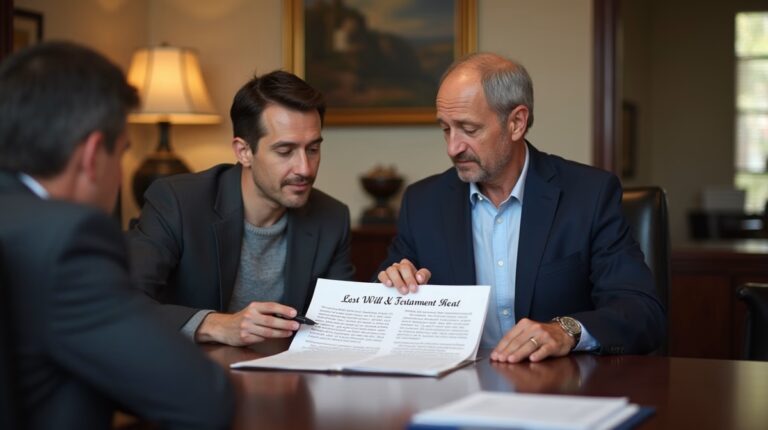
At its heart, a robust estate plan generally encompasses several key documents. First, a properly executed Last Will and Testament, although often superseded by a more comprehensive trust. A Revocable Living Trust allows you to maintain control of your assets during your lifetime while providing a seamless transfer to your beneficiaries upon your death, avoiding the often lengthy and expensive probate process. Advance Healthcare Directives, including both a Durable Power of Attorney for finances and a Healthcare Power of Attorney (sometimes combined into an Advance Healthcare Directive), are critical for outlining who can manage your finances and make healthcare decisions if you become incapacitated. Finally, a Pour-Over Will acts as a safety net, ensuring any assets inadvertently left outside the trust are automatically included.
How Does Estate Planning Help Avoid Probate?
Probate is the legal process of validating a will and administering an estate. It can be time-consuming, costly, and public. A Revocable Living Trust is the most effective tool for probate avoidance. Assets titled in the name of the trust bypass probate entirely, passing directly to your beneficiaries. However, for deaths occurring on or after April 1, 2025, assets exceeding $208,850 generally trigger full probate. However, per Probate Code § 13050, this calculation MUST exclude all California-registered vehicles (regardless of value), boats, and up to $20,875 in unpaid salary. Furthermore, AB 2016 now allows a simplified ‘Primary Residence’ petition for homes valued up to $750,000, significantly expanding probate shortcuts.
What About Proposition 19 and Property Taxes?
Proposition 19 significantly altered inheritance rules regarding property taxes. While it allows for the transfer of a primary residence to children or grandchildren, there are limitations. under Proposition 19, heirs only keep a parent’s low property tax base if they move into the home as their primary residence within one year. Critically, for 2026, the tax-free ‘basis boost’ is capped at $1,044,586 over the original taxable value; any value exceeding this adjusted cap results in a partial reassessment even if the child moves in. Careful planning is crucial to minimize potential tax burdens.
What Role Does a CPA-Attorney Play in Estate Planning?
After 35+ years practicing as both an Estate Planning Attorney and a Certified Public Accountant, I’ve seen firsthand the benefits of integrated legal and tax expertise. Many attorneys lack a deep understanding of tax implications, potentially overlooking significant estate tax liabilities or failing to maximize step-up in basis opportunities. As a CPA, I can structure your estate plan to minimize capital gains taxes and ensure accurate asset valuation, protecting more wealth for your heirs. This dual perspective is invaluable when dealing with complex assets or family business succession planning.
What About Digital Assets and Incapacity Planning?
Today’s estate plans must address digital assets – online accounts, cryptocurrency, and digital photos. Per the Revised Uniform Fiduciary Access to Digital Assets Act (RUFADAA), custodians like Apple or Google are legally prohibited from granting executors access to the content of emails or private messages without ‘explicit written direction’ in the will or trust. Metadata (the ‘catalog’) may be accessible, but the private content remains locked without this specific legal trigger. Furthermore, protecting your healthcare choices requires careful consideration. Under both federal HIPAA and the California Confidentiality of Medical Information Act (CMIA), medical providers are strictly barred from sharing details with family unless a HIPAA Release is integrated into the Advance Healthcare Directive. Without this, a spouse may be forced to obtain an emergency court-ordered conservatorship just to speak with a surgeon.
What Happens to My Business if I Become Incapacitated or Pass Away?
For business owners, estate planning is even more critical. It’s not just about your personal assets; it’s about the continuity of your business. A well-structured succession plan ensures a smooth transition, whether to family members, partners, or a sale. Failing to plan can lead to business disruption, loss of value, and even forced liquidation. under the Corporate Transparency Act (CTA), all non-exempt small businesses must maintain active BOI Reports with FinCEN. Upon the death of a member, the estate or successor has exactly 30 days from the date the estate is settled to file an updated report; failure to meet this window triggers non-waivable fines of $500 per day.
What standards do California judges use to determine a will’s true meaning?
In California, a last will and testament is reviewed under probate standards that focus on intent, capacity, and execution. Clear drafting reduces ambiguity, limits misinterpretation, and helps families avoid unnecessary conflict during estate administration.
To ensure the will functions as intended, the executor must understand their fiduciary obligations, while the family should be prepared for the court supervision required to enforce the document.
For California residents, understanding how intent, authority, and compliance interact is one of the most effective ways to protect family harmony and estate integrity. A will that anticipates probate scrutiny is far more likely to be honored as written and far less likely to become the source of unnecessary conflict.
Controlling Legal Standards Governing California Estate and Asset Transfers
-
Probate & Court Procedure:
California Courts – Wills, Estates, and Probate
The official judicial branch guide for navigating the probate process; it provides updated 2026 checklists for determining if an estate qualifies for “Summary Probate” under the $208,850 personal property limit or the $750,000 primary residence threshold (AB 2016). -
Property Tax Reassessment (Prop 19):
California State Board of Equalization (Prop 19)
The definitive resource for understanding the “Parent-to-Child” reassessment exclusion; it outlines the strict one-year deadline for heirs to move into an inherited home as their primary residence to maintain the parent’s low property tax base. -
Advance Healthcare Planning:
California Attorney General – Advance Health Care Directive
Provides the official California statutory form and legal guidelines for appointing a health care agent; this resource emphasizes the necessity of combining a medical power of attorney with a HIPAA release to ensure doctors can communicate with family during an emergency. -
Federal Estate & Gift Tax:
IRS Estate Tax Guidelines
The authoritative federal portal for estate and gift tax reporting; this page reflects the permanent exemption of $15 million per person (effective Jan 1, 2026), effectively replacing the previously scheduled Tax Cuts and Jobs Act (TCJA) sunset. -
Digital Asset Access (RUFADAA):
California RUFADAA Law (Probate Code §§ 870-884)
Access the full statutory text of the Revised Uniform Fiduciary Access to Digital Assets Act; it explains why executors are legally barred from accessing encrypted accounts, email, or crypto-wallets unless the decedent provided explicit “prior consent” in their estate plan.
|
Attorney Advertising, Legal Disclosure & Authorship
ATTORNEY ADVERTISING.
This content is provided for general informational and educational purposes only and does not constitute legal, financial, or tax advice. Under the California Rules of Professional Conduct and State Bar advertising regulations, this material may be considered attorney advertising. Reading this content does not create an attorney-client relationship or any professional advisory relationship. Laws vary by jurisdiction and are subject to change, including recent 2026 developments under California’s AB 2016 and evolving federal estate and reporting requirements. You should consult a qualified attorney or advisor regarding your specific circumstances before taking action.
Responsible Attorney:
Steven F. Bliss, California Attorney (Bar No. 147856).
Local Office:
The Law Firm of Steven F. Bliss Esq.43920 Margarita Rd Ste F Temecula, CA 92592 (951) 223-7000
The Law Firm of Steven F. Bliss Esq. is a practice location and trade name used by Steven F. Bliss, Esq., a California-licensed attorney.
About the Author & Legal Review Process
This article was researched and drafted by the Legal Editorial Team of the Law Firm of Steven F. Bliss, Esq.,
a collective of attorneys, legal writers, and paralegals dedicated to translating complex legal concepts into clear, accurate guidance.
Legal Review:
This content was reviewed and approved by Steven F. Bliss, a California-licensed attorney (Bar No. 147856). Mr. Bliss concentrates his practice in estate planning and estate administration, advising clients on proactive planning strategies and representing fiduciaries in probate and trust administration proceedings when formal court involvement becomes necessary.
With more than 35 years of experience in California estate planning and estate administration,
Mr. Bliss focuses on structuring enforceable estate plans, guiding fiduciaries through court-supervised proceedings, resolving creditor and notice issues, and coordinating asset management to support compliant, timely distributions and reduce fiduciary risk. |