This article is provided for general informational purposes only and does not constitute legal, financial, or tax advice.
Reading this content does not create an attorney-client or professional advisory relationship.
Laws vary by jurisdiction and are subject to change. You should consult a qualified professional regarding your specific circumstances.
Harvey just received devastating news: his wife’s hastily signed codicil, intended to leave a specific heirloom to their daughter, was deemed invalid. A technicality – a missing witness signature – meant the entire Will faced challenge. Now, Harvey is facing potential litigation, exorbitant legal fees, and the very real possibility that his estate will be distributed according to California’s default intestacy rules, bypassing his carefully considered wishes. The cost? Easily $50,000, and a fractured family.
The unlimited marital deduction is a cornerstone of estate planning, and while seemingly straightforward, its application can be surprisingly complex, especially when blended with California’s unique probate landscape. Clients often believe a simple “everything to my spouse” clause solves all problems, but that’s rarely the complete picture. It’s about more than just avoiding estate tax; it’s about preserving control, minimizing probate costs, and ensuring your assets ultimately reach your intended beneficiaries.
The federal estate tax, currently exceeding $13 million per individual, is the primary tax the unlimited marital deduction addresses. By transferring assets to a surviving spouse, no estate tax is due at that time. However, this merely postpones the tax liability until the surviving spouse’s death. For affluent couples, this can be a significant concern, particularly with potential future reductions in the federal exemption. But the implications extend far beyond federal estate tax, impacting state probate and asset protection strategies.
What Happens if My Will Isn’t Valid?
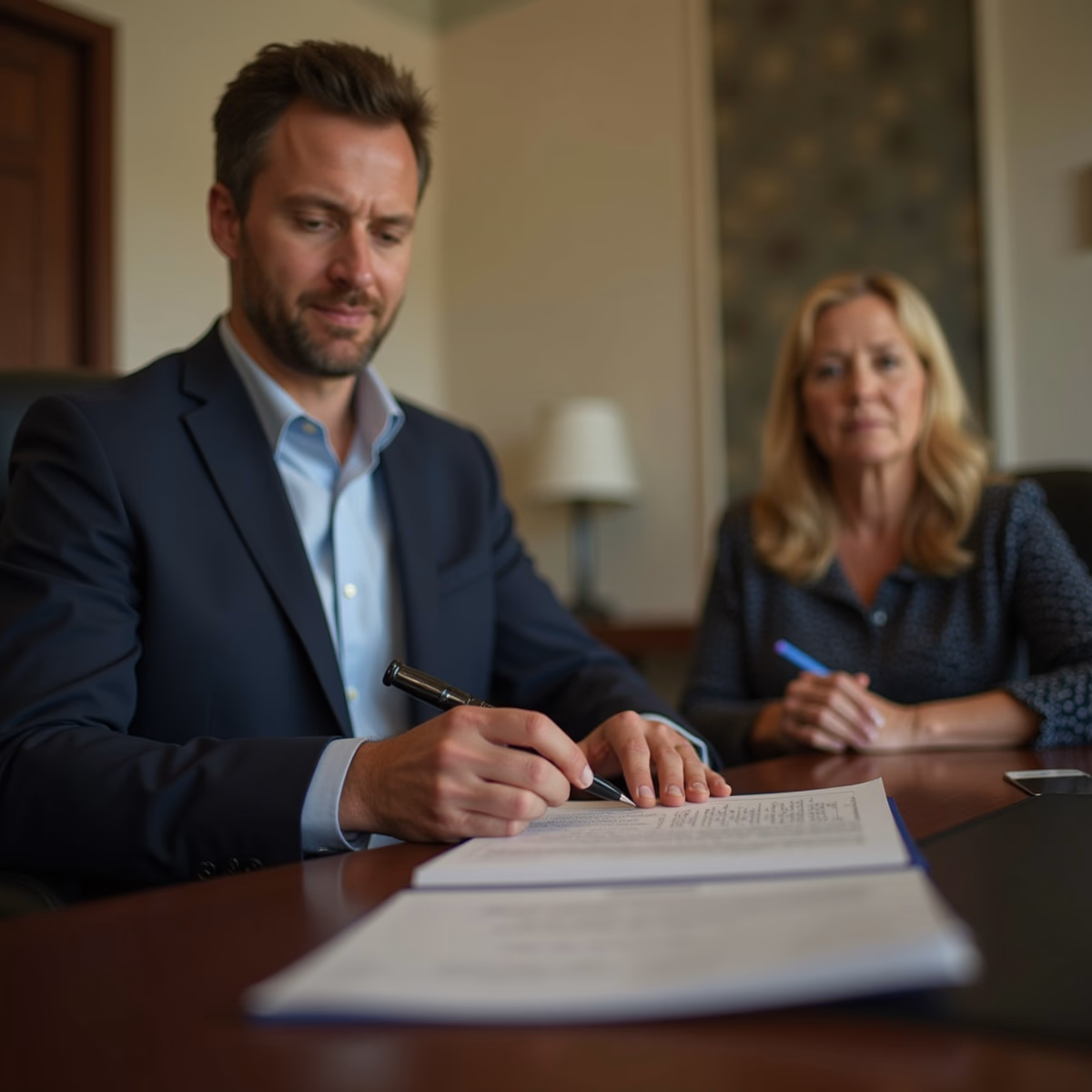
As Harvey’s situation illustrates, a flawed Will can unravel even the most meticulously planned estate. If a Will is invalidated – due to improper execution, lack of capacity, or undue influence – assets fall under intestacy; however, for deaths on or after April 1, 2025, estates with personal property under $208,850 (per CPC § 13100) may still bypass full probate via affidavit. This is a temporary reprieve, but larger estates will require full probate, a public and often lengthy court process.
How Does the Marital Deduction Work in California Probate?
In California, the marital deduction isn’t a set dollar amount, but rather a complete exemption for assets passing to a surviving spouse. This means the value of assets transferred to the spouse is entirely excluded from the deceased’s taxable estate for California purposes. However, it’s crucial to understand that simply naming your spouse as beneficiary doesn’t automatically guarantee a smooth transfer. Proper execution and unambiguous language are paramount.
What About Beneficiary Designations and Jointly Held Assets?
The unlimited marital deduction isn’t limited to assets passing through a Will or Trust. Assets with beneficiary designations – like life insurance policies and retirement accounts – and property held in joint tenancy with right of survivorship also avoid probate and benefit from the marital deduction. However, these assets bypass the Will entirely. This creates a potential disconnect: your Will might intend a certain distribution, but your beneficiary designations could dictate otherwise. A coordinated estate plan ensures alignment between all these elements.
Can a Spouse Disclaim Inheritance?
Yes, a surviving spouse can disclaim (refuse) an inheritance, but this has significant implications. A disclaimer effectively treats the disclaimed assets as if the deceased never owned them, passing instead according to the terms of their Will or, if no Will exists, under California’s intestacy laws. This can be a useful tool for tax planning or asset protection, but it’s crucial to understand the consequences and comply with strict legal requirements.
What Role Does a Trust Play in Maximizing the Marital Deduction?
While a Will can utilize the unlimited marital deduction, a properly funded revocable living trust offers greater flexibility and control. A trust allows assets to bypass probate entirely, accelerating the distribution process and maintaining privacy. Furthermore, a trust can include provisions for creditor protection, ensuring your assets are shielded from potential claims against your spouse. This is especially critical in professions with inherent liability risks or in situations involving blended families.
How Does My Experience as a CPA Benefit My Estate Planning Clients?
After 35+ years as both an Estate Planning Attorney and a Certified Public Accountant, I bring a unique perspective to my clients’ needs. Unlike many attorneys, I understand the intricacies of tax basis, capital gains, and asset valuation. The marital deduction is only one piece of the puzzle; managing the cost basis of inherited assets is equally crucial. For example, a step-up in basis at death can significantly reduce capital gains taxes when assets are eventually sold. Failing to address these issues can result in substantial, unnecessary tax liabilities.
Furthermore, as a CPA, I’m keenly aware of the potential pitfalls of inaccurate asset valuation, which can trigger IRS scrutiny. Proper valuation is essential for establishing a credible estate tax return and avoiding penalties.
What About Digital Assets and the New RUFADAA Law?
Digital assets – online accounts, cryptocurrency, digital photos, and more – present a unique challenge for estate planning. Effective 2025, California law (CPC § 871) was expanded to grant fiduciaries power over digital accounts; however, you must still grant explicit RUFADAA powers in your Will or Trust to bypass federal privacy blocks. Without this authorization, accessing your spouse’s digital assets can be difficult, if not impossible. This can include critical financial information, important memories, and potentially valuable assets.
What Happens if a Will Contains Mistakes?
Even seemingly minor errors in a Will’s execution can create major problems. Probate Code § 6110(c)(2) states the court may validate a signature-defective Will if there is ‘clear and convincing evidence’ of the testator’s intent; however, this requires a costly court petition and is not a guaranteed safety net. A self-proving affidavit, authorized by Probate Code § 8220, significantly streamlines the probate process by eliminating the need for witness testimony, but it must be properly executed. Similarly, if a beneficiary witnesses the Will, California Probate Code § 6112 creates a presumption of duress or fraud, potentially invalidating the gift.
While California allowed temporary remote witnessing during the pandemic, the law (CPC § 6110) has reverted to requiring strict simultaneous presence; remote signatures are generally invalid for Wills unless they meet the narrow ‘Electronic Will’ standards of AB 298.
What standards do California judges use to determine a will’s true meaning?
In California, a last will and testament operates within a probate system that emphasizes intent, clarity, and procedural compliance. When properly drafted, a will does more than distribute property—it creates legally enforceable instructions that guide courts, fiduciaries, and beneficiaries through administration with fewer disputes and less uncertainty.
| Core Focus | Impact |
|---|---|
| Clear Wishes | Clear intent reduces judicial guesswork. |
| Formal Validity | Proper execution strengthens enforceability. |
| Assigned Control | Defined roles reduce conflict. |
For California residents, understanding how intent, authority, and compliance interact is one of the most effective ways to protect family harmony and estate integrity. A will that anticipates probate scrutiny is far more likely to be honored as written and far less likely to become the source of unnecessary conflict.
Resources for Legal Standards & Probate Procedure
-
Riverside Local Rules: Riverside Superior Court – Probate Division
Access the essential “Local Rules” (Title 7) effective January 1, 2026. This includes mandatory usage of the eSubmit Document Submission Portal, current Probate Examiner notes, and specific requirements for remote appearances via the court’s designated platform. -
Attorney Verification: State Bar of California
The official regulatory body for California attorneys. Use this to verify a lawyer’s “Certified Specialist” status in Estate Planning or to access 2026 guidelines on the ethical handling of Client Trust Accounts (IOLTA). -
Self-Help & Forms: California Courts – Wills, Estates, and Probate
The Judicial Council’s official portal. It includes the updated 2026 forms for the $208,850 personal property threshold and the $750,000 “Primary Residence” simplified transfer procedure (AB 2016). -
Federal Estate Tax Exemption: IRS Estate Tax Guidelines
The authoritative federal resource for estate and gift tax filing. It reflects the permanent exemption of $15 million per individual (effective Jan 1, 2026), replacing the previously scheduled Tax Cuts and Jobs Act (TCJA) sunset.
|
Attorney Advertising, Legal Disclosure & Authorship
ATTORNEY ADVERTISING.
This content is provided for general informational and educational purposes only and does not constitute legal, financial, or tax advice. Under the California Rules of Professional Conduct and State Bar advertising regulations, this material may be considered attorney advertising. Reading this content does not create an attorney-client relationship or any professional advisory relationship. Laws vary by jurisdiction and are subject to change, including recent 2026 developments under California’s AB 2016 and evolving federal estate and reporting requirements. You should consult a qualified attorney or advisor regarding your specific circumstances before taking action.
Responsible Attorney:
Steven F. Bliss, California Attorney (Bar No. 147856).
Local Office:
The Law Firm of Steven F. Bliss Esq.43920 Margarita Rd Ste F Temecula, CA 92592 (951) 223-7000
The Law Firm of Steven F. Bliss Esq. is a practice location and trade name used by Steven F. Bliss, Esq., a California-licensed attorney.
About the Author & Legal Review Process
This article was researched and drafted by the Legal Editorial Team of the Law Firm of Steven F. Bliss, Esq.,
a collective of attorneys, legal writers, and paralegals dedicated to translating complex legal concepts into clear, accurate guidance.
Legal Review:
This content was reviewed and approved by Steven F. Bliss, a California-licensed attorney (Bar No. 147856). Mr. Bliss concentrates his practice in estate planning and estate administration, advising clients on proactive planning strategies and representing fiduciaries in probate and trust administration proceedings when formal court involvement becomes necessary.
With more than 35 years of experience in California estate planning and estate administration,
Mr. Bliss focuses on structuring enforceable estate plans, guiding fiduciaries through court-supervised proceedings, resolving creditor and notice issues, and coordinating asset management to support compliant, timely distributions and reduce fiduciary risk. |