
|
Legal & Tax Disclosure
ATTORNEY ADVERTISING.
This article is provided for general informational purposes only and does not constitute legal, financial, or tax advice. Reading this content does not create an attorney-client or professional advisory relationship. Laws vary by jurisdiction and are subject to change. You should consult a qualified professional regarding your specific circumstances. |
Lillian just received devastating news. Her mother, Beatrice, passed away unexpectedly while snowbirding in Arizona. Beatrice meticulously prepared a will in California, naming Lillian as executor. Now, Lillian’s aunt is claiming Beatrice was a legal resident of Arizona and demanding the probate be opened there. The potential cost to Lillian – legal fees, delays, and a family feud – could easily exceed $50,000. The core issue? Establishing Beatrice’s domicile, and whether an executor’s decision on that matter is final.
The short answer is no, your executor doesn’t have the sole authority to decide your domicile. While they are tasked with administering your estate according to your wishes and the law, domicile is a complex legal question of fact determined by evidence, not simply a declaration. It’s a common misconception that naming an executor grants them absolute control over where your estate is settled. They can believe you were a California resident, and act accordingly, but that belief doesn’t automatically make it so.
Domicile, for legal purposes, is far more than just a mailing address or where you spend your time. It’s your true, fixed, and permanent home – the place you intend to return to, even during absences. This is critically important for both probate jurisdiction and, crucially, for tax implications. California, like other states, has specific rules about who is considered a resident for estate tax purposes, and incorrect application of those rules can lead to significant penalties.
As an estate planning attorney and CPA with over 35 years of experience, I frequently encounter situations like Lillian’s. The intersection of legal residence, probate, and tax law is particularly nuanced. My CPA credential allows me to see beyond the legal formalities and delve into the financial reality of a client’s situation – the impact of a stepped-up basis in real estate, potential capital gains taxes, and accurate valuation of assets, all of which are tied to domicile.
The executor’s role is to gather evidence demonstrating your intent. This includes things like where you were registered to vote, the location of your driver’s license, where you paid state income taxes, the location of your primary bank accounts, and your healthcare providers. However, that evidence is subject to scrutiny. If a family member – like Lillian’s aunt – challenges the domicile, it will be up to the probate court to decide. The court will weigh all available evidence, and often consider factors beyond just the executor’s assertion.
Furthermore, the question of domicile isn’t always clear-cut, especially in cases involving “snowbirds” who split their time between states. Spending less than 183 days in California does not automatically terminate residency; the FTB uses the ‘Closest Connection’ test (evaluating 19 factors like your primary doctor and social ties) to determine domicile. The FTB will meticulously examine your life through Form 4600 (Residency Questionnaire) – looking at the location of your dentist, the registration of your pets, and even where you keep your safe deposit boxes.
It’s vital to proactively address this potential conflict. Clear documentation – a signed declaration of domicile, instructions in your will, and a well-organized record of your financial and personal connections to California – can significantly strengthen your executor’s position. We often advise clients to maintain a comprehensive “Domicile File” outlining their intent and supporting evidence.
What if Beatrice owned a home in Arizona? That complicates things further. For deaths on or after April 1, 2025, a primary residence valued up to $750,000 may qualify for a ‘Petition for Succession’ under AB 2016 (Probate Code § 13151). However, it’s crucial to remember this is a Petition that requires a Judge’s Order, not a simple affidavit. And, critically, to qualify, Beatrice’s other non-real estate assets (cash, stocks, etc.) typically needed to remain below the separate $208,850 Small Estate limit. Don’t confuse the streamlined procedures for smaller estates with the full probate process required for larger ones.
What does a California probate court look for when interpreting testamentary intent?
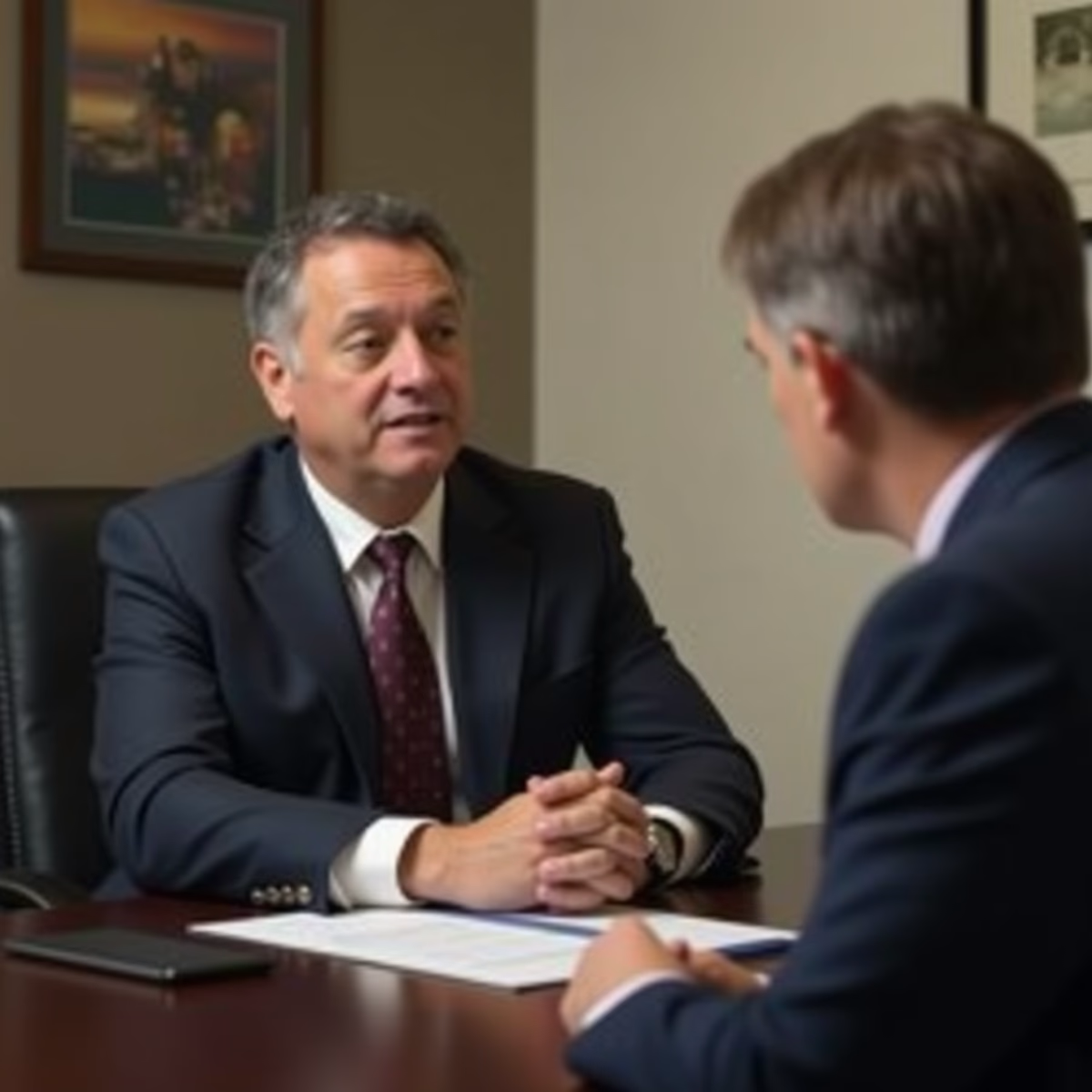
In California, a last will and testament is reviewed under probate standards that focus on intent, capacity, and execution. Clear drafting reduces ambiguity, limits misinterpretation, and helps families avoid unnecessary conflict during estate administration.
| Key Element | Why It Matters |
|---|---|
| Clear Wishes | Clear intent reduces judicial guesswork. |
| Compliance | Proper execution strengthens enforceability. |
| Assigned Control | Proper designation prevents power struggles. |
When a will is drafted with California probate review in mind, it becomes a stabilizing roadmap rather than a source of conflict. Clear intent, proper authority, and compliant execution protect both families and estates.
Controlling Legal Standards for Establishing Domicile and Residency
-
Residency Guidelines: FTB Pub 1031 (Guidelines for Determining Resident Status)
This is the primary resource for the “Closest Connection” test. In 2026, it details how the FTB evaluates 19 factors—including the location of your healthcare providers and social ties—to determine if your presence in the state is “permanent” or merely “transitory.” -
Voter Registration: California Secretary of State – Voter Registration
Updating your voting address is a critical indicator of intent. For the June 2, 2026, Primary Election, the deadline to register online is May 18, 2026. This serves as a public declaration of your primary home. -
Federal Estate Tax: IRS Estate Tax Overview
While domicile determines state tax, this resource outlines federal guidelines. It reflects the permanent federal estate tax exemption of $15 million per person ($30 million for couples), effective Jan 1, 2026. -
Proof of Residency: California DMV – REAL ID Checklist
Since the federal enforcement deadline passed in 2025, a REAL ID is mandatory for domestic flights. This page lists the specific residency documents (e.g., utility bills, tax returns) that the state accepts as proof of a permanent California address.
|
Attorney Advertising, Legal Disclosure & Authorship
ATTORNEY ADVERTISING.
This content is provided for general informational and educational purposes only and does not constitute legal, financial, or tax advice. Under the California Rules of Professional Conduct and State Bar advertising regulations, this material may be considered attorney advertising. Reading this content does not create an attorney-client relationship or any professional advisory relationship. Laws vary by jurisdiction and are subject to change, including recent 2026 developments under California’s AB 2016 and evolving federal estate and reporting requirements. You should consult a qualified attorney or advisor regarding your specific circumstances before taking action.
Responsible Attorney:
Steven F. Bliss, California Attorney (Bar No. 147856).
Local Office:
The Law Firm of Steven F. Bliss Esq.43920 Margarita Rd Ste F Temecula, CA 92592 (951) 223-7000
The Law Firm of Steven F. Bliss Esq. is a practice location and trade name used by Steven F. Bliss, Esq., a California-licensed attorney.
About the Author & Legal Review Process
This article was researched and drafted by the Legal Editorial Team of the Law Firm of Steven F. Bliss, Esq.,
a collective of attorneys, legal writers, and paralegals dedicated to translating complex legal concepts into clear, accurate guidance.
Legal Review:
This content was reviewed and approved by Steven F. Bliss, a California-licensed attorney (Bar No. 147856). Mr. Bliss concentrates his practice in estate planning and estate administration, advising clients on proactive planning strategies and representing fiduciaries in probate and trust administration proceedings when formal court involvement becomes necessary.
With more than 35 years of experience in California estate planning and estate administration,
Mr. Bliss focuses on structuring enforceable estate plans, guiding fiduciaries through court-supervised proceedings, resolving creditor and notice issues, and coordinating asset management to support compliant, timely distributions and reduce fiduciary risk. |