
This article is provided for general informational purposes only and does not constitute legal, financial, or tax advice.
Reading this content does not create an attorney-client or professional advisory relationship.
Laws vary by jurisdiction and are subject to change. You should consult a qualified professional regarding your specific circumstances.
Floyd received the call on a Tuesday – his mother, Evelyn, had passed away peacefully in her sleep. He’d braced for grief, for logistical challenges, but not for this. Six months after probate closed, a credit card application surfaced in Evelyn’s name, followed by a fraudulent tax return. The estate had to endure a costly legal battle to prove the identity theft occurred after her death, tying up assets and delaying distributions to his sister. Had Evelyn’s trust included specific post-death identity theft protections, this nightmare could have been avoided.
As an estate planning attorney and CPA with over 35 years of experience here in Temecula, I’ve seen firsthand how devastating post-death identity theft can be. It’s not just a financial hit; it’s an emotional burden on grieving families already navigating a difficult time. While we focus heavily on asset protection during life, the vulnerabilities extend well beyond the grave.
What specific threats do estates face after the grantor’s death?
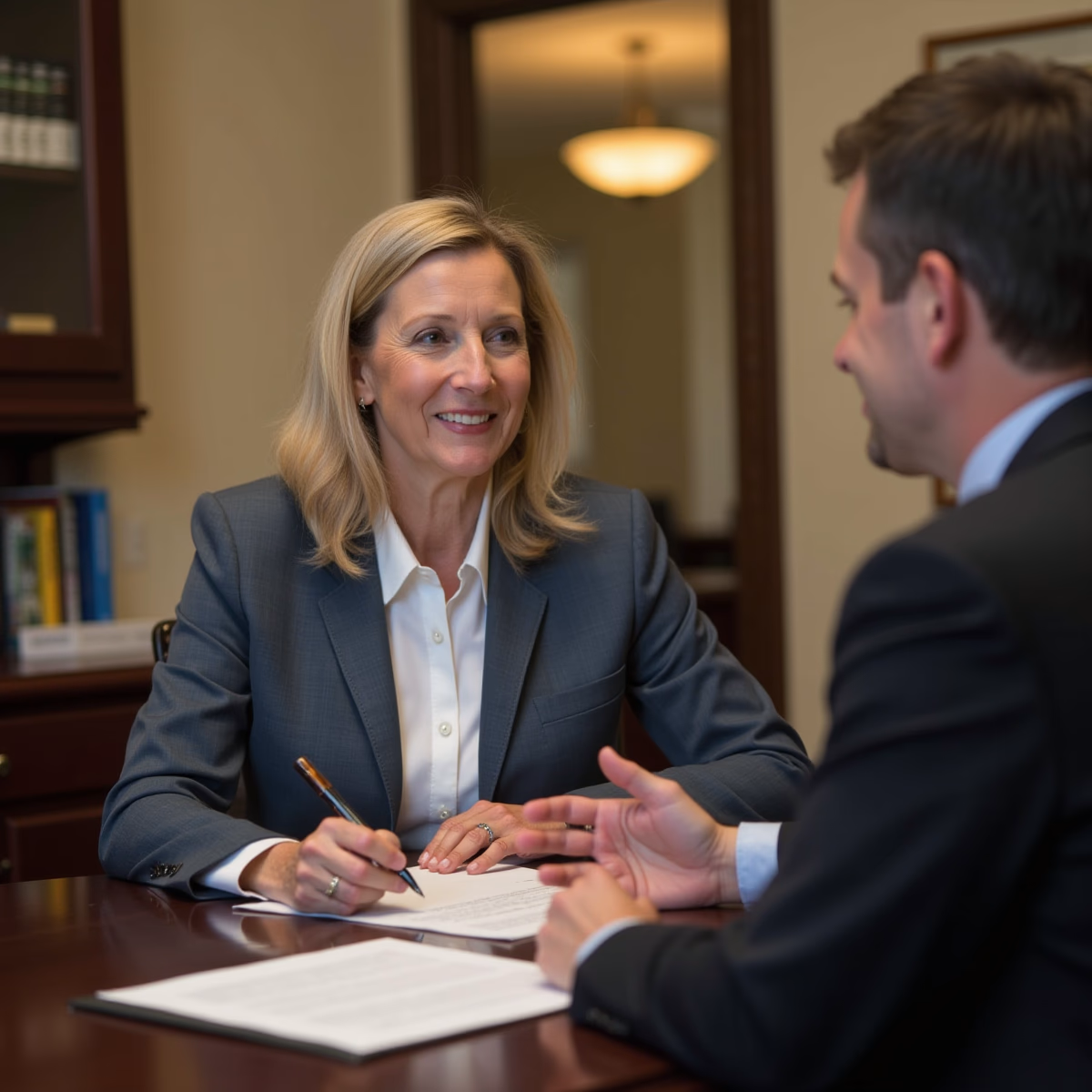
The types of fraud we see are evolving. It used to be primarily fraudulent claims against life insurance policies. Now, it’s far broader – opening new credit accounts, filing false tax returns (as in Floyd’s case), even accessing existing bank accounts with forged documents. The rise of sophisticated phishing scams targeting bereaved families is particularly concerning. These scammers often prey on publicly available death notices, obtaining enough information to pose as legitimate heirs or beneficiaries.
Can a trust actually prevent identity theft after death?
While we can’t guarantee absolute prevention, a well-drafted trust can significantly mitigate the risks. We routinely incorporate several protective clauses. First, a clear directive to the trustee to actively monitor credit reports and financial accounts for any unauthorized activity. This means requesting a credit freeze with all three major credit bureaus immediately upon death. Secondly, we include language authorizing the trustee to respond to credit inquiries, confirming the grantor’s death to prevent accounts from being opened fraudulently. Finally, and critically, we specify that the trustee has the authority to provide proof of death documentation – a certified death certificate – only to verified legitimate entities.
How does being a CPA influence my approach to post-death estate planning?
My CPA background is invaluable in this area. Often, the initial red flag is a suspicious tax return. I understand the intricacies of final tax filings and can anticipate potential fraudulent activity. Moreover, I’m acutely aware of the importance of “step-up in basis” for inherited assets. If a fraudulent transaction occurs and negatively impacts the asset’s value, it can affect the cost basis and ultimately, the capital gains tax liability for the beneficiaries. Accurate valuation is key, and a CPA’s expertise is crucial in defending against IRS challenges.
What if the trustee discovers fraudulent activity? What steps should they take?
Prompt action is essential. First, immediately notify all relevant credit bureaus and financial institutions. File a police report and a complaint with the Federal Trade Commission (FTC). The trustee should also consider obtaining a legal opinion to determine the appropriate course of action, which may involve engaging a forensic accountant to trace the fraudulent transactions. It’s important to meticulously document all findings and communications, as this will be critical evidence in any legal proceedings. Remember, Probate Code § 16062 mandates that trustees provide accountings to beneficiaries, and failing to address fraud could lead to breach of fiduciary duty claims.
What about real estate held in the trust? Are there specific considerations?
Absolutely. We often hold real estate within a revocable living trust to avoid probate. However, this property is also vulnerable. Scammers might attempt to fraudulently transfer title or obtain a mortgage. We include language granting the trustee broad authority to defend against such attempts and to take all necessary legal action to protect the property. Furthermore, if the property is being transferred to a child, we carefully review Prop 19 to ensure compliance with property tax exclusion rules and avoid unintended reassessments.
What happens if a crucial asset was inadvertently left out of the trust?
It happens more often than you think. Perhaps a small brokerage account was overlooked, or a piece of property wasn’t properly titled. For deaths occurring on or after April 1, 2025, we have new options available. Specifically, AB 2016 (Probate Code § 13151) allows for a ‘Petition for Succession’—a court order—for smaller, unintentionally omitted assets (valued up to $750,000), including a primary residence. This is a more streamlined process than a full probate. It’s vital to understand this is a Petition requesting a Judge’s Order, not a simple ‘Affidavit’ as was previously used for small estate procedures. A proper cleanup prevents further complications down the line.
Are there notification requirements the trustee must adhere to?
Yes. In California, the trustee has a strict duty to notify heirs and beneficiaries. Probate Code § 16061.7 requires that within 60 days of the settlor’s death, the trustee must serve the ‘Notification by Trustee’ to all heirs and beneficiaries; this triggers the 120-day statute of limitations for contesting the trust, which is the trustee’s primary shield against future litigation. Failure to comply with this notification requirement can expose the trustee to significant liability.
Finally, what about estate tax implications, especially with changes on the horizon?
The OBBBA—effective Jan 1, 2026—permanently set the Federal Estate Tax Exemption to $15 million per person. Trustees must determine if the estate exceeds this threshold (taking into account portability elections from the deceased spouse, if applicable) before closing administration. Accurate estate tax planning, guided by both legal and accounting principles, is critical to minimize tax liabilities and ensure a smooth transfer of wealth. Additionally, if the trust involves business interests held in LLCs, the FinCEN 2025 Exemption should be considered, though trustees managing foreign-registered entities will still need to comply with BOI reporting requirements within 30 days of the settlor’s death.
What determines whether a California trust settlement remains private or erupts into public litigation?
The advantage of a California trust is control and continuity, but this relies entirely on accurate funding and disciplined administration. Without clear asset titles and strict adherence to fiduciary standards, a private trust can quickly become a subject of public litigation over mismanagement, capacity, or undue influence.
- Safety: Review blind trusts.
- Detail: Check probate-trust hybrids.
- Growth: Manage dynasty trust.
Ultimately, the success of a trust depends on the details—proper funding, clear terms, and a trustee willing to follow the rules. By anticipating friction points and documenting every step of the administration, fiduciaries can protect the estate and themselves from liability.
Verified Authority on California Trust Administration
-
Mandatory Notification (Probate Code § 16061.7): California Probate Code § 16061.7
The first critical step in administration. This statute requires the trustee to notify all heirs and beneficiaries within 60 days of death. It starts the 120-day clock for any contests, limiting the trustee’s liability. -
Trustee’s Duty to Account (Probate Code § 16062): California Probate Code § 16062
Defines the requirement for annual and final accountings. Trustees must report all receipts, disbursements, and changes in asset value to beneficiaries to ensure transparency and avoid surcharges. -
Primary Residence Succession (AB 2016): California Probate Code § 13151 (Petition for Succession)
Effective April 1, 2025, this statute is a “rescue” tool for administration. If a home (up to $750,000) was left out of the trust, the trustee can petition for this order rather than opening a full probate. -
Property Tax Reassessment (Prop 19): California State Board of Equalization (Prop 19)
Trustees must understand these rules before signing a deed to a beneficiary. Distributing real estate without filing the Parent-Child Exclusion claim can accidentally double or triple the property taxes for the heirs. -
Federal Estate Tax Exemption: IRS Estate Tax Guidelines
Reflects the permanent increase to a $15 million per person exemption (effective Jan 1, 2026). Trustees must evaluate if an IRS Form 706 is necessary to preserve “portability” of the unused exemption for a surviving spouse. -
Digital Asset Access (RUFADAA): California Probate Code § 870 (RUFADAA)
Without explicit authority under this statute, a trustee may be blocked from accessing the decedent’s online banking, email, or cryptocurrency accounts, stalling the administration process.
|
Attorney Advertising, Legal Disclosure & Authorship
ATTORNEY ADVERTISING.
This content is provided for general informational and educational purposes only and does not constitute legal, financial, or tax advice. Under the California Rules of Professional Conduct and State Bar advertising regulations, this material may be considered attorney advertising. Reading this content does not create an attorney-client relationship or any professional advisory relationship. Laws vary by jurisdiction and are subject to change, including recent 2026 developments under California’s AB 2016 and evolving federal estate and reporting requirements. You should consult a qualified attorney or advisor regarding your specific circumstances before taking action.
Responsible Attorney:
Steven F. Bliss, California Attorney (Bar No. 147856).
Local Office:
The Law Firm of Steven F. Bliss Esq.43920 Margarita Rd Ste F Temecula, CA 92592 (951) 223-7000
The Law Firm of Steven F. Bliss Esq. is a practice location and trade name used by Steven F. Bliss, Esq., a California-licensed attorney.
About the Author & Legal Review Process
This article was researched and drafted by the Legal Editorial Team of the Law Firm of Steven F. Bliss, Esq.,
a collective of attorneys, legal writers, and paralegals dedicated to translating complex legal concepts into clear, accurate guidance.
Legal Review:
This content was reviewed and approved by Steven F. Bliss, a California-licensed attorney (Bar No. 147856). Mr. Bliss concentrates his practice in estate planning and estate administration, advising clients on proactive planning strategies and representing fiduciaries in probate and trust administration proceedings when formal court involvement becomes necessary.
With more than 35 years of experience in California estate planning and estate administration,
Mr. Bliss focuses on structuring enforceable estate plans, guiding fiduciaries through court-supervised proceedings, resolving creditor and notice issues, and coordinating asset management to support compliant, timely distributions and reduce fiduciary risk. |