
|
Legal & Tax Disclosure
ATTORNEY ADVERTISING.
This article is provided for general informational purposes only and does not constitute legal, financial, or tax advice. Reading this content does not create an attorney-client or professional advisory relationship. Laws vary by jurisdiction and are subject to change. You should consult a qualified professional regarding your specific circumstances. |
Dax lost everything. He’d meticulously drafted his Will, believing he’d covered all bases. But when he passed, the bank account containing the bulk of his assets was solely in his name, payable-on-death to his daughter. The Will, containing instructions for the remaining, smaller assets, was overlooked. Now, his daughter faces a full Probate case, racking up legal fees on an estate that would have qualified for a much simpler, cheaper process. It’s a painful lesson in asset titling and contingency planning.
As an Estate Planning Attorney and CPA with over 35 years of experience here in Temecula, I frequently encounter situations where families needlessly endure the complexity and expense of formal Probate. Often, a streamlined Small Estate Affidavit process would have sufficed. The key lies in understanding the thresholds and requirements.
What is the Probate Threshold?
Many people assume any estate, regardless of size, must go through Probate. That’s simply not true. In California, filing a Petition for Probate (Form DE-111) is mandatory if the decedent’s gross estate value exceeds $208,850 (effective April 1, 2025). Below this amount, successors should use the Section 13100 Small Estate Affidavit or AB 2016 Petition for Succession instead. This threshold includes all assets owned by the decedent at the time of death – real estate, bank accounts, investments, vehicles, and personal property. It’s crucial to accurately value these assets to determine the appropriate path.
When Can I Use the Small Estate Affidavit?
The Small Estate Affidavit, governed by California Probate Code Section 13100, allows you to transfer assets directly to the rightful heirs without court supervision, if the estate falls below the aforementioned threshold. This is a significant benefit. It eliminates court filings, attorney fees, and the lengthy delays associated with formal Probate. However, there are strict requirements. You must wait 40 days after the date of death to apply, and all debts and taxes must be paid. It’s also critical to obtain written consent from all beneficiaries, acknowledging they have received their rightful share.
What About Jointly Held Property?
Jointly held property – like a house owned with right of survivorship – bypasses Probate entirely. It automatically transfers to the surviving owner, regardless of the estate’s size. Similarly, assets with designated beneficiaries, such as life insurance policies or retirement accounts, pass directly to those named beneficiaries outside of Probate. This is why proper asset titling is paramount. A well-structured estate plan minimizes the assets subject to Probate, maximizing efficiency and reducing costs.
What Happens if the Will Isn’t Found in Time?
A common issue arises when the original Will isn’t immediately located. Probate Code § 8200 dictates that the person holding the decedent’s original Will has a mandatory legal duty to file it with the Court Clerk within 30 days of learning of the death. Failure to do so can make the custodian liable for all damages caused by the delay. If the Will is lost or destroyed, it doesn’t necessarily invalidate the entire estate plan, but it adds a layer of complexity. You’ll need to prove the Will’s contents through witness testimony and a formal declaration. A copy of the Will is not sufficient for filing; the court requires proof of the original’s existence and contents.
What if There’s a Dispute Over Who Gets What?
If beneficiaries disagree about the distribution of assets, even within the Small Estate Affidavit process, it can quickly escalate into a legal battle. Probate Code § 8461 outlines a strict Order of Priority if there is no Will (Intestacy): (1) Surviving Spouse, (2) Children, (3) Grandchildren, (4) Parents, (5) Siblings. A friend or unmarried partner has zero priority unless specifically named in a Will. Disputes often arise when blended families are involved, or when there’s ambiguity regarding the decedent’s intentions.
Why a CPA-Attorney is Advantageous
My background as both an Estate Planning Attorney and a CPA gives me a unique advantage when guiding clients through these processes. I understand the crucial interplay between legal and tax implications. For example, a proper ‘step-up in basis’ calculation can significantly reduce capital gains taxes when inherited assets are eventually sold. I can also provide expert valuation services for assets that might be close to the Probate threshold, ensuring compliance and minimizing tax liability. This holistic approach is often overlooked by attorneys who lack a strong accounting background.
How do enforcement rules in California probate court shape outcomes for heirs and fiduciaries?
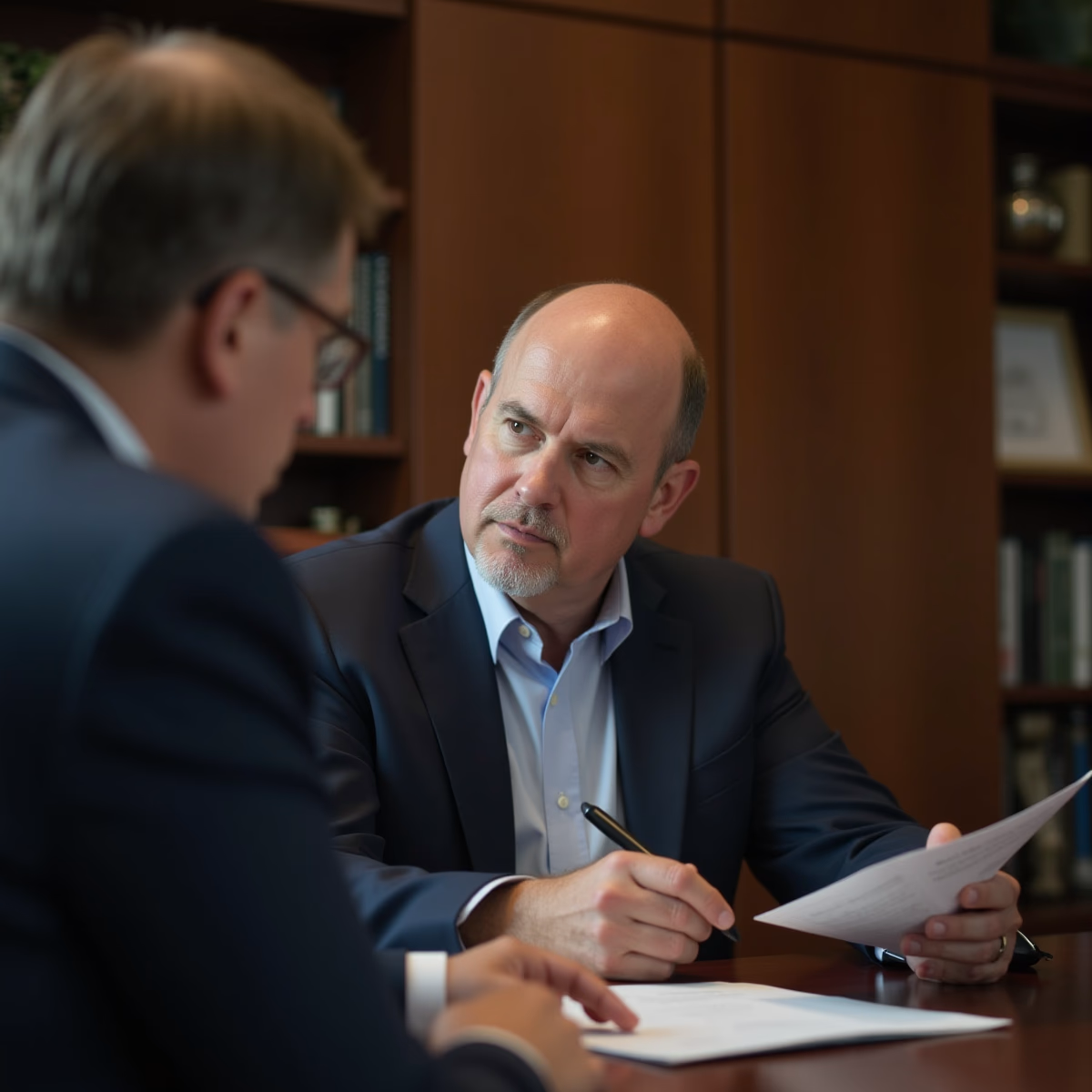
California probate is designed to provide court-supervised transfer of property, yet cases often break down when authority is unclear, required steps are missed, or disputes arise over assets, notice, and fiduciary conduct. When the process is misunderstood, families can face avoidable delay, escalating conflict, and increased exposure to creditor issues, hearings, or litigation before the estate can close.
- Options: Explore ways to avoid probate.
- Details: Check specific considerations.
- Administration: Manage administering a probate estate.
Ultimately, the difference between a routine distribution and a protracted legal battle often comes down to preparation. By anticipating the demands of the Probate Code and addressing potential friction points with beneficiaries and creditors upfront, fiduciaries can navigate the system with greater confidence and lower liability.
Verified Authority on the Petition for Probate
-
The Petition (Form DE-111): California Probate Code § 8000 (Grounds for Filing)
This is the document that starts it all. Under Section 8000, any interested person may file this petition to request the court admit a will to probate and appoint a personal representative. Without this filing, the court has no jurisdiction to act. -
Duty to File the Will: California Probate Code § 8200 (Custodian Duty)
Holding onto the original Will is a liability. The law requires the custodian to deliver the Will to the Superior Court Clerk within 30 days of the death. Hiding or destroying a Will to prevent probate is a serious legal violation. -
Priority for Appointment: California Probate Code § 8461 (Intestacy Hierarchy)
When there is no Will, the court does not choose the “best” person; it follows a rigid statutory list. The Surviving Spouse has top priority, followed by children, then grandchildren. Understanding this hierarchy helps predict who will win a contested appointment. -
Probate Bond Requirements: California Probate Code § 8482 (Bond Amount)
The bond acts as an insurance policy to protect beneficiaries from a dishonest executor. The petition must state the estimated value of the estate so the judge can set the bond amount—typically the value of personal property plus one year’s estimated income. -
Independent Administration (IAEA): California Probate Code § 10400
The box you check here matters. Requesting “Full Authority” under the IAEA allows the executor to manage the estate efficiently (e.g., selling a house) without constant court hearings. Requesting “Limited Authority” forces the estate into a slower, court-supervised process. -
Proving a Lost Will: California Probate Code § 6124 (Presumption of Revocation)
If the original Will cannot be found, the law presumes the decedent destroyed it with the intent to revoke it. To overcome this presumption, the petitioner must provide clear and convincing evidence that the Will was merely lost, not revoked.
|
Attorney Advertising, Legal Disclosure & Authorship
ATTORNEY ADVERTISING.
This content is provided for general informational and educational purposes only and does not constitute legal, financial, or tax advice. Under the California Rules of Professional Conduct and State Bar advertising regulations, this material may be considered attorney advertising. Reading this content does not create an attorney-client relationship or any professional advisory relationship. Laws vary by jurisdiction and are subject to change, including recent 2026 developments under California’s AB 2016 and evolving federal estate and reporting requirements. You should consult a qualified attorney or advisor regarding your specific circumstances before taking action.
Local Office:
The Law Firm of Steven F. Bliss Esq.43920 Margarita Rd Ste F Temecula, CA 92592 (951) 223-7000
The Law Firm of Steven F. Bliss Esq. is a practice location and trade name used by Steven F. Bliss, Esq., a California-licensed attorney.
About the Author & Legal Review Process
This article was researched and drafted by the Legal Editorial Team of the Law Firm of Steven F. Bliss, Esq.,
a collective of attorneys, legal writers, and paralegals dedicated to translating complex legal concepts into clear, accurate guidance.
Legal Review:
This content was reviewed and approved by Steven F. Bliss, a California-licensed attorney (Bar No. 147856). Mr. Bliss concentrates his practice in estate planning and estate administration, advising clients on proactive planning strategies and representing fiduciaries in probate and trust administration proceedings when formal court involvement becomes necessary.
With more than 35 years of experience in California estate planning and estate administration,
Mr. Bliss focuses on structuring enforceable estate plans, guiding fiduciaries through court-supervised proceedings, resolving creditor and notice issues, and coordinating asset management to support compliant, timely distributions and reduce fiduciary risk. |