
This article is provided for general informational purposes only and does not constitute legal, financial, or tax advice.
Reading this content does not create an attorney-client or professional advisory relationship.
Laws vary by jurisdiction and are subject to change. You should consult a qualified professional regarding your specific circumstances.
Carmen discovered a codicil to her mother’s estate plan… crumpled in the glove compartment of a decades-old car, partially eaten by silverfish. Even worse, the original will was nowhere to be found. The potential cost? Years of litigation, fractured family relationships, and tens of thousands of dollars in legal fees—all because a single, crucial document wasn’t properly secured and witnessed.
When someone dies without a valid will in California – what we call dying “intestate” – their assets don’t simply vanish. Instead, distribution is governed by a strict set of rules outlined in the California Probate Code. It’s rarely as simple or efficient as what the deceased would have dictated in a thoughtfully prepared estate plan. The process can be complex, time-consuming, and ultimately, more expensive than the cost of creating a will in the first place.
What is Intestate Succession?
Intestate succession is the legal process that determines how a person’s property is distributed when they die without a will. California law prioritizes certain family members, and the share each receives depends on the surviving relatives. This isn’t a free-for-all; it’s a hierarchical system, and the specifics can be surprisingly intricate.
For example, if a person dies with a surviving spouse and children, the spouse typically receives one-half of the community property and one-third of the separate property. The children then divide the remaining two-thirds of the separate property equally. If there’s no spouse but surviving children, the children split everything. If there’s a spouse but no children, the spouse receives all of the separate property and one-half of the community property. These aren’t mere suggestions; they’re legally binding rules.
What Happens to the Estate?
The first step is typically opening a probate case in the Superior Court of the county where the deceased resided. A qualified individual – usually a close family member – petitions the court to be appointed as the “Personal Representative” (formerly known as the Executor). This person is responsible for identifying and collecting the deceased’s assets, paying debts and taxes, and ultimately, distributing the remaining property to the legal heirs.
The court will scrutinize the petition and, if approved, issue “Letters Testamentary” (or “Letters of Administration” in an intestate case), granting the Personal Representative the authority to act on behalf of the estate. That’s when the real work begins. Assets must be appraised, debts verified, and potential disputes among heirs resolved. Probate cannot be closed until the mandatory 4-month creditor claim period expires under Probate Code § 9100. This window begins the day ‘Letters’ are issued to the representative, serving as a mandatory cooling-off period even if the estate has no known debts.
The Role of a CPA in Intestate Estates
As both an Estate Planning Attorney and a Certified Public Accountant (CPA) with over 35 years of experience, I often see the significant tax implications that arise in intestate estates. A CPA’s expertise is crucial in maximizing the “step-up in basis” for inherited assets. This means that the heirs receive a new cost basis equal to the fair market value of the assets on the date of death, potentially eliminating years of capital gains taxes. Accurate valuation is paramount, and a CPA can provide invaluable assistance in this area.
Furthermore, understanding the interplay between state probate law and federal estate tax regulations is essential. While the 2026 ‘TCJA Sunset’ was officially averted by the One Big Beautiful Bill Act (OBBBA). As of January 1, 2026, the Federal Estate Tax Exemption is permanently set at $15 million per person ($30 million for married couples), effectively eliminating the federal ‘Death Tax’ for nearly all families, navigating the tax landscape still requires careful planning.
What About Small Estates?
California law provides a simplified probate process for “small estates.” For deaths occurring on or after April 1, 2025, the small estate threshold for personal property is $208,850 (per CPC § 13100). This allows heirs to skip full probate via affidavit. This rate is fixed and will not adjust again until April 1, 2028. If the total value of the deceased’s probate assets (excluding things like jointly held property and life insurance) falls below this threshold, heirs can petition the court for a simplified transfer of assets.
Additionally, under AB 2016, primary residences valued at $750,000 or less qualify for simplified transfer for deaths on or after April 1, 2025. In 2026, this remains active law, allowing qualifying homes to bypass formal probate via a simplified petition rather than a 12-month court process.
Avoiding Probate Altogether
While simplified procedures exist, the best way to avoid the complexities of intestate succession is to create a comprehensive estate plan. This includes a will, but also potentially trusts, powers of attorney, and advance healthcare directives. A properly funded trust can bypass probate entirely, allowing assets to be transferred directly to beneficiaries quickly and efficiently.
Finally, it’s vital to understand that unless explicitly waived in the Will or by all beneficiaries in writing, the court mandates a Surety Bond per Probate Code § 8482. This bond protects the estate’s value; the premium is calculated based on the total value of personal property plus annual income, often costing the estate thousands in non-refundable fees. Proper planning can often eliminate the need for this costly requirement.
What makes a California will legally enforceable when it matters most?
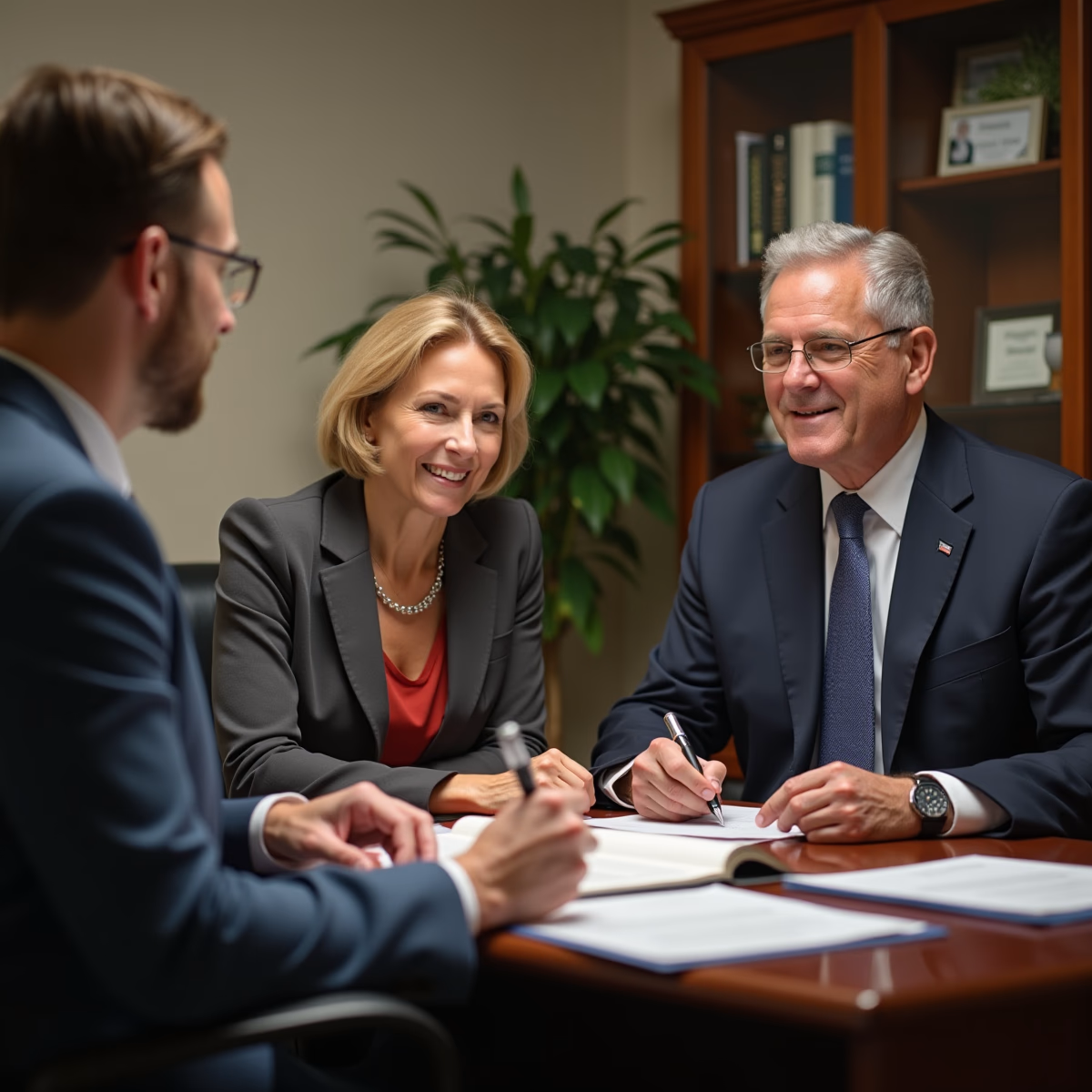
In California, a last will and testament operates within a probate system that emphasizes intent, clarity, and procedural compliance. When properly drafted, a will does more than distribute property—it creates legally enforceable instructions that guide courts, fiduciaries, and beneficiaries through administration with fewer disputes and less uncertainty.
| Final Stage | Consideration |
|---|---|
| IRS | Address final expenses. |
| Payout | Manage assets. |
| Family | Protect inheritance rights. |
For California residents, understanding how intent, authority, and compliance interact is one of the most effective ways to protect family harmony and estate integrity. A will that anticipates probate scrutiny is far more likely to be honored as written and far less likely to become the source of unnecessary conflict.
Official 2026 California Probate Standards & Resources
-
Probate Process: California Courts – Probate Overview
This official judicial guide provides a high-level roadmap of the California probate system, defining the roles of executors and administrators while clarifying which assets are subject to court supervision and which bypass the process entirely. -
Unclaimed Property: California State Controller – Unclaimed Property
A vital resource for estate representatives to search the “Estates of Deceased Persons File,” which contains millions in forgotten bank accounts, uncashed checks, and insurance benefits that must be marshaled and reported as part of a complete estate inventory. -
Probate Code: Probate Code § 13100 (Small Estate Affidavit)
The primary statute governing the simplified collection of personal property; as of 2026, it allows successors to bypass probate for estates valued at $208,850 or less (for deaths after April 1, 2025), provided a 40-day waiting period has elapsed. -
Local Court Rules: Riverside Superior Court – Probate Division
Provides essential “Local Rules” and “Proposed Form Changes” effective January 1, 2026, including specific requirements for remote appearances and the mandatory use of the Riverside eSubmit Document Submission Portal for all probate matters in the Inland Empire. -
Tax Guidelines: Franchise Tax Board – Estates and Trusts
The official California tax portal for fiduciaries, outlining the 2026 filing requirements for Form 541 (Fiduciary Income Tax Return) and explaining when real estate withholding (Form 593) is required for the sale of inherited property.
|
Attorney Advertising, Legal Disclosure & Authorship
ATTORNEY ADVERTISING.
This content is provided for general informational and educational purposes only and does not constitute legal, financial, or tax advice. Under the California Rules of Professional Conduct and State Bar advertising regulations, this material may be considered attorney advertising. Reading this content does not create an attorney-client relationship or any professional advisory relationship. Laws vary by jurisdiction and are subject to change, including recent 2026 developments under California’s AB 2016 and evolving federal estate and reporting requirements. You should consult a qualified attorney or advisor regarding your specific circumstances before taking action.
Responsible Attorney:
Steven F. Bliss, California Attorney (Bar No. 147856).
Local Office:
The Law Firm of Steven F. Bliss Esq.43920 Margarita Rd Ste F Temecula, CA 92592 (951) 223-7000
The Law Firm of Steven F. Bliss Esq. is a practice location and trade name used by Steven F. Bliss, Esq., a California-licensed attorney.
About the Author & Legal Review Process
This article was researched and drafted by the Legal Editorial Team of the Law Firm of Steven F. Bliss, Esq.,
a collective of attorneys, legal writers, and paralegals dedicated to translating complex legal concepts into clear, accurate guidance.
Legal Review:
This content was reviewed and approved by Steven F. Bliss, a California-licensed attorney (Bar No. 147856). Mr. Bliss concentrates his practice in estate planning and estate administration, advising clients on proactive planning strategies and representing fiduciaries in probate and trust administration proceedings when formal court involvement becomes necessary.
With more than 35 years of experience in California estate planning and estate administration,
Mr. Bliss focuses on structuring enforceable estate plans, guiding fiduciaries through court-supervised proceedings, resolving creditor and notice issues, and coordinating asset management to support compliant, timely distributions and reduce fiduciary risk. |