|
Legal & Tax Disclosure
ATTORNEY ADVERTISING.
This article is provided for general informational purposes only and does not constitute legal, financial, or tax advice. Reading this content does not create an attorney-client or professional advisory relationship. Laws vary by jurisdiction and are subject to change. You should consult a qualified professional regarding your specific circumstances. |
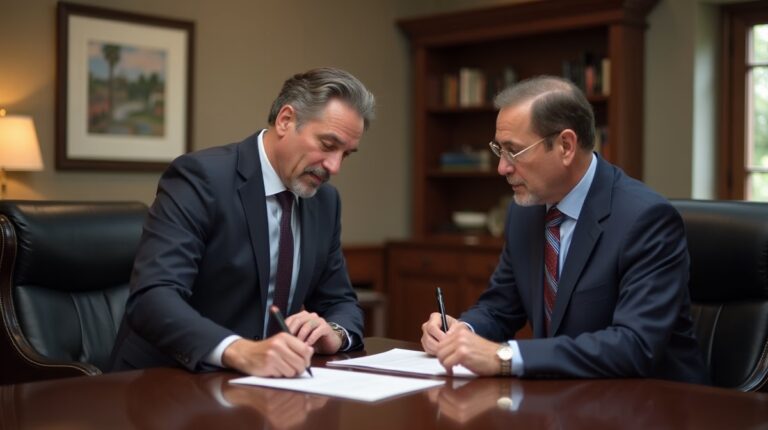
Lillian discovered a devastating error just weeks before her wedding. Her fiancé, David, had drafted a prenuptial agreement, but it was carelessly executed – a crucial page was missing the signature line, rendering the entire document unenforceable. Simultaneously, David’s ongoing attempt to establish California domicile for tax purposes was crumbling under FTB scrutiny. The combined legal mess, initially thought to be a $5,000 fix, now threatened to cost them over $75,000 in potential exposure.
Can a prenuptial agreement be invalidated if it wasn’t properly signed?

Absolutely. A prenuptial agreement, like any contract, must meet specific requirements to be valid. This includes proper execution – meaning all parties must sign the agreement, and those signatures must be witnessed and notarized. Missing signature lines, improperly witnessed documents, or failures to meet other technical requirements can render the agreement unenforceable. The absence of even a single signature on a critical page, as in Lillian and David’s case, is often fatal to the entire agreement. California courts will strictly scrutinize prenuptial agreements, particularly when there’s a claim of procedural error. This is especially true if one party alleges they were pressured or didn’t fully understand the terms.
How does domicile impact prenuptial agreements and estate planning?
Domicile – your true, fixed, and permanent home – is critically important. It determines which state’s laws govern your estate, including the validity and enforcement of your prenuptial agreement. If David had successfully established California as his domicile, California law would govern the prenuptial agreement. However, if his domicile remained elsewhere, the laws of that state would apply, potentially leading to a different outcome. Establishing domicile isn’t simply about spending time in a state; it’s about demonstrating intent to remain there permanently.
What factors do courts consider when determining domicile?
Determining domicile is a fact-intensive process. Courts look at a variety of factors, including where you live, vote, pay taxes, own property, have professional licenses, and maintain social and family ties. Merely owning property in California or spending a few months here isn’t enough. The California Franchise Tax Board (FTB) is particularly diligent in these cases. They will examine your entire life to assess whether you truly intended to make California your permanent home. Spending less than 183 days in California does not automatically terminate residency; the FTB uses the ‘Closest Connection’ test (evaluating 19 factors like your primary doctor and social ties) to determine domicile.
How can the FTB challenge a claimed California domicile?
The FTB employs several methods to challenge a claimed California domicile. They can issue an audit and request documentation supporting your residency claim. They’ll use Form 4600 (Residency Questionnaire) to scrutinize your life, including the location of your dentist, the registration of your pets, and where you keep your safe deposit boxes. They also look at where you have bank accounts, where your investments are held, and where you receive mail. A weak residency claim can lead to significant tax liabilities, as California taxes income from all sources, regardless of where it’s earned.
What role does a CPA-Attorney play in these complex situations?
As an Estate Planning Attorney and CPA with over 35 years of experience, I often encounter these intertwined issues. The dual perspective is invaluable. A CPA understands the tax implications of domicile and asset ownership, while an attorney can ensure the prenuptial agreement is legally sound and enforceable. I can analyze the impact of domicile on the agreement, navigate the FTB’s scrutiny, and structure assets to minimize potential tax liabilities. A significant benefit is the ability to accurately calculate the “step-up in basis” for inherited assets, crucial for minimizing capital gains taxes. Proper valuation of assets, especially business interests, is another area where a CPA’s expertise is critical.
What happens if a prenuptial agreement fails, and the domicile is challenged?
If both issues collapse simultaneously, the consequences can be severe. Without a valid prenuptial agreement, marital assets are divided according to California’s community property laws, which may not align with the couple’s intentions. If the domicile is successfully challenged, the estate may be subject to the laws of another state, potentially leading to higher taxes or a different distribution of assets. In Lillian and David’s situation, we had to scramble to re-draft the prenuptial agreement and gather evidence supporting David’s California domicile before the wedding, a costly and stressful endeavor.
Are there any recent changes to California probate law that impact estate planning?
Yes. For deaths on or after April 1, 2025, a primary residence valued up to $750,000 qualifies for a ‘Petition for Succession’ under AB 2016 (Probate Code § 13151). This simplifies the transfer of real estate after death. However, you must be aware that this is a Petition that requires a Judge’s Order, NOT an Affidavit. It’s important to note that to qualify, the decedent’s other non-real estate assets (cash, stocks, etc.) must typically remain below the separate $208,850 Small Estate limit. Keep in mind that the Small Estate Affidavit (strictly for real property <$69,625, used for timeshares/vacant land) remains an option for smaller estates.
What makes a California will legally enforceable when it matters most?
In California, a last will and testament operates within a probate system that emphasizes intent, clarity, and procedural compliance. When properly drafted, a will does more than distribute property—it creates legally enforceable instructions that guide courts, fiduciaries, and beneficiaries through administration with fewer disputes and less uncertainty.
- Clarity: Avoid vague terms that trigger probate disputes.
- Incapacity: verify legal capacity at signing.
- Omissions: check for codicils often.
For California residents, understanding how intent, authority, and compliance interact is one of the most effective ways to protect family harmony and estate integrity. A will that anticipates probate scrutiny is far more likely to be honored as written and far less likely to become the source of unnecessary conflict.
Controlling Legal Standards for Establishing Domicile and Residency
-
Residency Guidelines: FTB Pub 1031 (Guidelines for Determining Resident Status)
This is the primary resource for the “Closest Connection” test. In 2026, it details how the FTB evaluates 19 factors—including the location of your healthcare providers and social ties—to determine if your presence in the state is “permanent” or merely “transitory.” -
Voter Registration: California Secretary of State – Voter Registration
Updating your voting address is a critical indicator of intent. For the June 2, 2026, Primary Election, the deadline to register online is May 18, 2026. This serves as a public declaration of your primary home. -
Federal Estate Tax: IRS Estate Tax Overview
While domicile determines state tax, this resource outlines federal guidelines. It reflects the permanent federal estate tax exemption of $15 million per person ($30 million for couples), effective Jan 1, 2026. -
Proof of Residency: California DMV – REAL ID Checklist
Since the federal enforcement deadline passed in 2025, a REAL ID is mandatory for domestic flights. This page lists the specific residency documents (e.g., utility bills, tax returns) that the state accepts as proof of a permanent California address.
|
Attorney Advertising, Legal Disclosure & Authorship
ATTORNEY ADVERTISING.
This content is provided for general informational and educational purposes only and does not constitute legal, financial, or tax advice. Under the California Rules of Professional Conduct and State Bar advertising regulations, this material may be considered attorney advertising. Reading this content does not create an attorney-client relationship or any professional advisory relationship. Laws vary by jurisdiction and are subject to change, including recent 2026 developments under California’s AB 2016 and evolving federal estate and reporting requirements. You should consult a qualified attorney or advisor regarding your specific circumstances before taking action.
Responsible Attorney:
Steven F. Bliss, California Attorney (Bar No. 147856).
Local Office:
The Law Firm of Steven F. Bliss Esq.43920 Margarita Rd Ste F Temecula, CA 92592 (951) 223-7000
The Law Firm of Steven F. Bliss Esq. is a practice location and trade name used by Steven F. Bliss, Esq., a California-licensed attorney.
About the Author & Legal Review Process
This article was researched and drafted by the Legal Editorial Team of the Law Firm of Steven F. Bliss, Esq.,
a collective of attorneys, legal writers, and paralegals dedicated to translating complex legal concepts into clear, accurate guidance.
Legal Review:
This content was reviewed and approved by Steven F. Bliss, a California-licensed attorney (Bar No. 147856). Mr. Bliss concentrates his practice in estate planning and estate administration, advising clients on proactive planning strategies and representing fiduciaries in probate and trust administration proceedings when formal court involvement becomes necessary.
With more than 35 years of experience in California estate planning and estate administration,
Mr. Bliss focuses on structuring enforceable estate plans, guiding fiduciaries through court-supervised proceedings, resolving creditor and notice issues, and coordinating asset management to support compliant, timely distributions and reduce fiduciary risk. |