
|
Legal & Tax Disclosure
ATTORNEY ADVERTISING.
This article is provided for general informational purposes only and does not constitute legal, financial, or tax advice. Reading this content does not create an attorney-client or professional advisory relationship. Laws vary by jurisdiction and are subject to change. You should consult a qualified professional regarding your specific circumstances. |
Emily just called, frantic. Her father, Warren, recently amended his trust, significantly increasing the benefit to his new caregiver, Leo. Emily and her siblings are convinced Leo manipulated Warren, especially given his sudden lavish gifts and a new sports car Warren hadn’t driven in decades. They’ve threatened a lawsuit, but Warren’s trustee is already warning about “no-contest” clauses. Emily’s real fear isn’t just the potential loss of inheritance, though – it’s that Warren, now 88 and increasingly confused, is actively draining the trust during this legal fight, blowing through funds on impulsive purchases Leo seems to encourage. She wants to know if initiating litigation will at least freeze the assets and prevent further depletion.
The short answer is: not automatically. Litigation, while sometimes necessary, doesn’t inherently come with a “freeze” on trust assets. A lawsuit alone doesn’t restrain a trustee’s power to administer the trust according to its terms, and that includes distributions, even if those distributions seem reckless or motivated by undue influence. We have to take specific legal steps to achieve that protection, and timing is critical.
What Legal Tools Can We Use to Halt Spending?
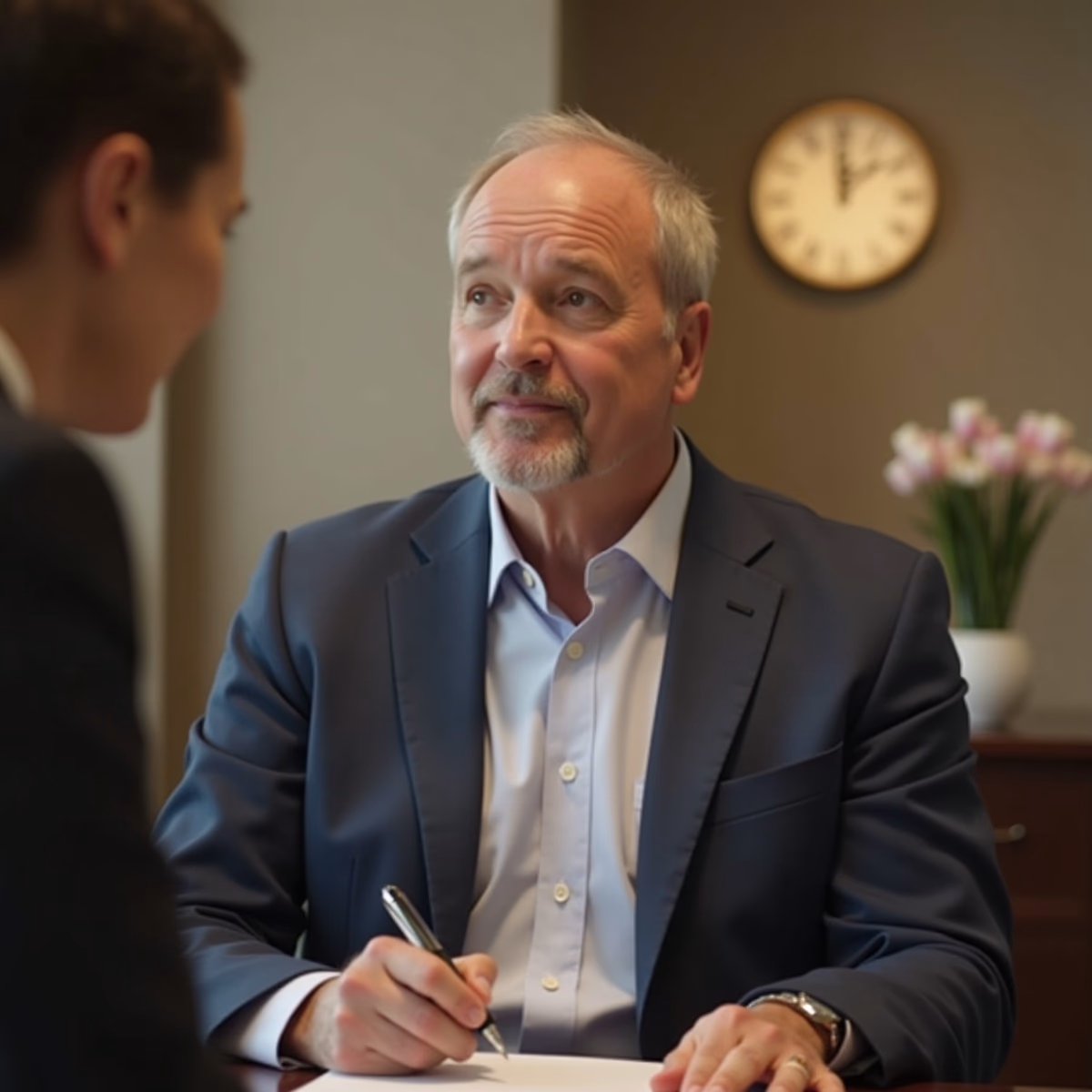
Several options exist, but each requires a proactive petition to the court, not just the filing of a lawsuit. The most common are Temporary Restraining Orders (TROs) and Preliminary Injunctions. A TRO is a short-term emergency measure, typically lasting 21 days, designed to preserve the status quo until a full hearing can be held. To obtain a TRO, we must demonstrate immediate and irreparable harm – in this case, the rapidly diminishing trust funds due to Warren’s impulsive spending. We’d need concrete evidence of the spending, preferably recent bank statements or receipts detailing questionable transactions.
A Preliminary Injunction is a longer-term solution, requiring a more thorough evidentiary hearing. Here, we must prove a likelihood of success on the merits of the underlying claim (undue influence, lack of capacity, etc.) and that the harm to Emily and her siblings outweighs the potential harm to Warren if the spending is restricted. This often involves expert testimony from a geriatric psychiatrist to evaluate Warren’s mental state.
How Does a “No-Contest” Clause Affect These Options?
This is where things get tricky, and Emily’s concern is valid. Probate Code § 21311 governs “No-Contest Clauses,” also known as in terrorem clauses. These clauses essentially state that if a beneficiary challenges the validity of the trust, they forfeit their inheritance. However, the law provides a crucial caveat: the clause is only enforceable if the challenger brought the lawsuit without probable cause.
This means we need to carefully assess the strength of our evidence before filing suit. Simply alleging undue influence isn’t enough; we need demonstrable proof, like suspicious financial transactions, evidence of Leo isolating Warren from his family, or changes to the trust that radically depart from Warren’s prior estate planning intentions. If we can show probable cause, the no-contest clause shouldn’t be a bar to recovery, even if we lose the initial challenge.
What About Digital Evidence? Can Texts or Emails Help?
In today’s world, a lot of undue influence happens through digital communication. Texts, emails, and even social media messages can reveal manipulative behavior or demonstrate Warren’s diminished capacity. However, obtaining this evidence isn’t always straightforward. Without specific RUFADAA authority (Probate Code § 870), a trustee or beneficiary may be legally blocked from subpoenaing critical digital evidence (emails, DMs, cloud logs) needed to prove undue influence or incapacity. We often need to file a separate motion with the court specifically authorizing the subpoena of this digital data.
What If the Assets Are Disappearing Very Quickly?
In situations with extreme urgency, we can pursue an expedited hearing for a TRO. We might also consider a petition for appointment of a temporary co-trustee. This would allow a neutral third party to share control of the trust assets with the existing trustee, providing a check on impulsive spending. Another option, particularly concerning a primary residence, is to be aware of the changes in law impacting simpler transfer processes. For deaths on or after April 1, 2025, if the dispute involves a home valued up to $750,000 that isn’t titled in the trust, a ‘Petition for Succession’ under AB 2016 (Probate Code § 13151) may be a faster resolution than a full Heggstad trial. It’s important to distinguish this as a “Petition” (Judge’s Order), NOT an “Affidavit.”
How Can a CPA Help Navigate This?
As both an Estate Planning Attorney and a Certified Public Accountant with over 35 years of experience, I often see these scenarios unfold. The CPA side of my practice is invaluable here. Understanding the tax implications of these transactions is crucial. For example, a sudden, large gift might trigger gift tax consequences, and the subsequent sale of an asset could generate significant capital gains. Properly documenting the “basis” (original cost) of assets is also vital for calculating potential estate tax liability. Knowing how to maximize the step-up in basis at Warren’s death – and minimizing capital gains along the way – can preserve significantly more wealth for the beneficiaries. It’s not just about recovering assets; it’s about protecting their tax-advantaged value.
What If We Discover Misappropriation of Funds?
If we uncover evidence that the trustee (or Warren, under Leo’s influence) has actually misappropriated funds – meaning they used trust assets for their personal benefit – we can petition the court under Probate Code § 16420 for remedies including removal of the trustee, surcharge (requiring personal repayment of the misused funds), and, in egregious cases, double damages. This adds another layer of complexity to the litigation, but it’s an important avenue to pursue if there’s evidence of wrongdoing.
Ultimately, litigation doesn’t automatically stop impulsive spending. It requires proactive legal action, a thorough understanding of the relevant probate laws, and a strategic approach tailored to the specific facts of the case.
How do California trustee duties and funding rules shape the outcome for beneficiaries?
The advantage of a California trust is control and continuity, but this relies entirely on accurate funding and disciplined administration. Without clear asset titles and strict adherence to fiduciary standards, a private trust can quickly become a subject of public litigation over mismanagement, capacity, or undue influence.
To manage complex legacy goals, you can secure privacy for public figures with privacy trust structures, or preserve wealth across multiple generations by establishing a dynasty trust that resists dilution over time.
Ultimately, the success of a trust depends on the details—proper funding, clear terms, and a trustee willing to follow the rules. By anticipating friction points and documenting every step of the administration, fiduciaries can protect the estate and themselves from liability.
Verified Authority on California Trust Litigation & Disputes
-
The 120-Day Rule (Probate Code § 16061.7): California Probate Code § 16061.7 (Trust Notification)
The most critical statute in trust litigation. It establishes the 120-day deadline for contesting a trust after the notification is mailed. Missing this deadline usually ends the case before it starts. -
Caregiver Presumption (Probate Code § 21380): California Probate Code § 21380 (Care Custodian Presumption)
This statute protects seniors by presuming that gifts to care custodians are the result of fraud or undue influence. It is the primary weapon used to overturn “deathbed amendments” that favor a caregiver over family. -
No-Contest Clauses (Probate Code § 21311): California Probate Code § 21311 (Enforcement Limits)
Defines the strict limits on enforcing penalty clauses. It explains that a beneficiary can only be disinherited for suing if they lacked “probable cause” to bring the lawsuit. -
Petition for Instructions (Probate Code § 17200): California Probate Code § 17200 (Internal Affairs)
The “gateway” statute for most trust litigation. It allows a trustee or beneficiary to petition the court for instructions regarding the internal affairs of the trust, from interpreting terms to removing a trustee. -
Asset Recovery “Backup” (AB 2016): California Probate Code § 13151 (Petition for Succession)
Effective April 1, 2025, this statute provides a streamlined path (Judge’s Order) to resolve disputes over ownership of a primary residence valued up to $750,000, often avoiding costly Heggstad litigation. -
Digital Discovery (RUFADAA): California Probate Code § 870 (RUFADAA)
Essential for modern litigation. This act governs who can access a decedent’s digital communications—often the “smoking gun” evidence in undue influence or capacity trials.
|
Attorney Advertising, Legal Disclosure & Authorship
ATTORNEY ADVERTISING.
This content is provided for general informational and educational purposes only and does not constitute legal, financial, or tax advice. Under the California Rules of Professional Conduct and State Bar advertising regulations, this material may be considered attorney advertising. Reading this content does not create an attorney-client relationship or any professional advisory relationship. Laws vary by jurisdiction and are subject to change, including recent 2026 developments under California’s AB 2016 and evolving federal estate and reporting requirements. You should consult a qualified attorney or advisor regarding your specific circumstances before taking action.
Responsible Attorney:
Steven F. Bliss, California Attorney (Bar No. 147856).
Local Office:
The Law Firm of Steven F. Bliss Esq.43920 Margarita Rd Ste F Temecula, CA 92592 (951) 223-7000
The Law Firm of Steven F. Bliss Esq. is a practice location and trade name used by Steven F. Bliss, Esq., a California-licensed attorney.
About the Author & Legal Review Process
This article was researched and drafted by the Legal Editorial Team of the Law Firm of Steven F. Bliss, Esq.,
a collective of attorneys, legal writers, and paralegals dedicated to translating complex legal concepts into clear, accurate guidance.
Legal Review:
This content was reviewed and approved by Steven F. Bliss, a California-licensed attorney (Bar No. 147856). Mr. Bliss concentrates his practice in estate planning and estate administration, advising clients on proactive planning strategies and representing fiduciaries in probate and trust administration proceedings when formal court involvement becomes necessary.
With more than 35 years of experience in California estate planning and estate administration,
Mr. Bliss focuses on structuring enforceable estate plans, guiding fiduciaries through court-supervised proceedings, resolving creditor and notice issues, and coordinating asset management to support compliant, timely distributions and reduce fiduciary risk. |